Seattle Public Schools

Projects

Lincoln Track and Field

Track and Athletic Field for Lincoln High School

Latest News

Tree reports

Community Meeting on Field Location Options

Thank you for joining us on Saturday, April 25 at Hamilton International Middle School.

At this meeting we shared our evaluation of the final two location options for an athletic field at Woodland Park: an additional field at Lower Woodland Field #2 (Option A) or a new field at N. 50th Street and Aurora Avenue N. (Option B or Option C).

You can download the presentation as a PDF fileor view it as slides below.

Title slide for Lincoln High School Field and Track community meeting on April 25, 2026, listing presenters from Seattle Public Schools and project partners. Seattle Public Schools and Building for Learning logos appear at the bottom.
Agenda text with two images: Two students on an outdoor athletic field, one riding on the other’s back, with a soccer goal and school buildings in the background. and A group of students wearing sports uniforms walk together across a field at sunset.
Land acknowledgement slide
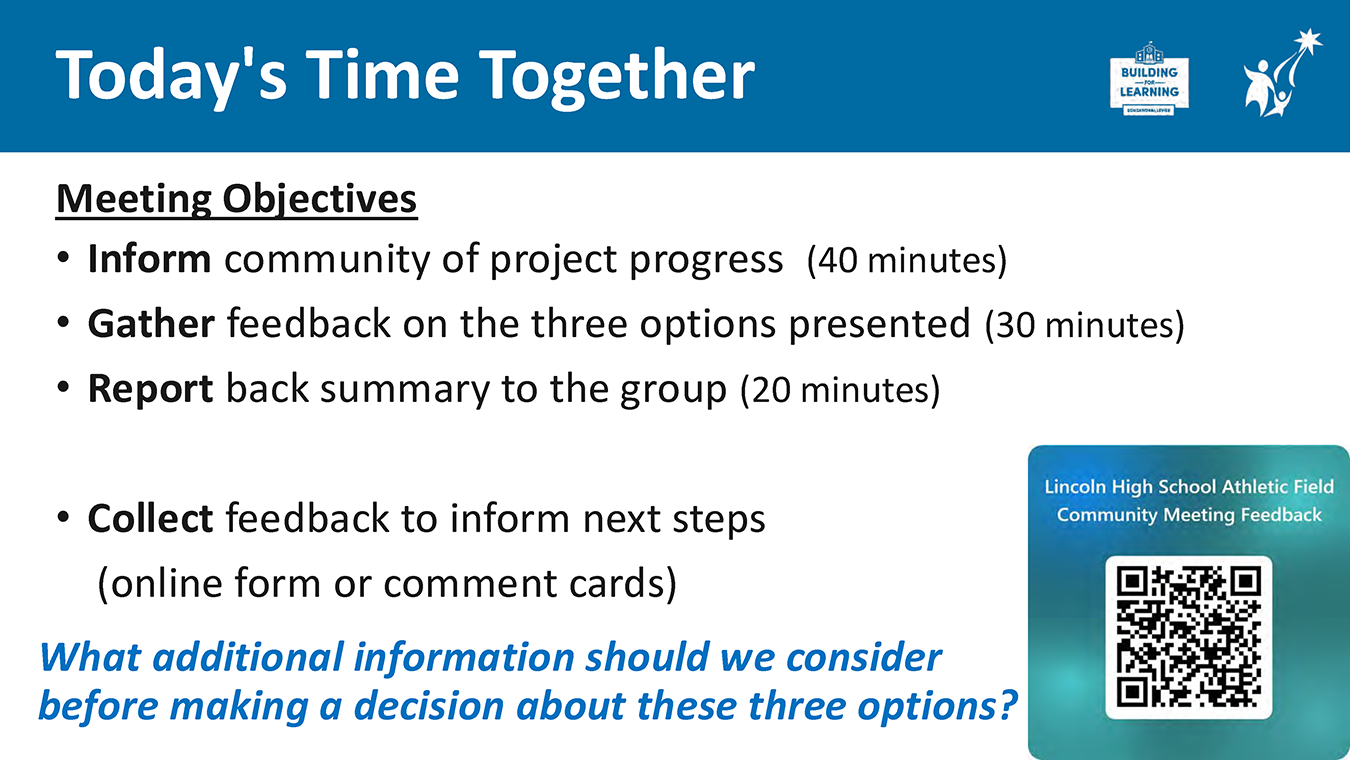
Slide titled ‘Today’s Time Together’ outlining meeting objectives, time allocations, and a prompt for community feedback. With a QR code for feedback
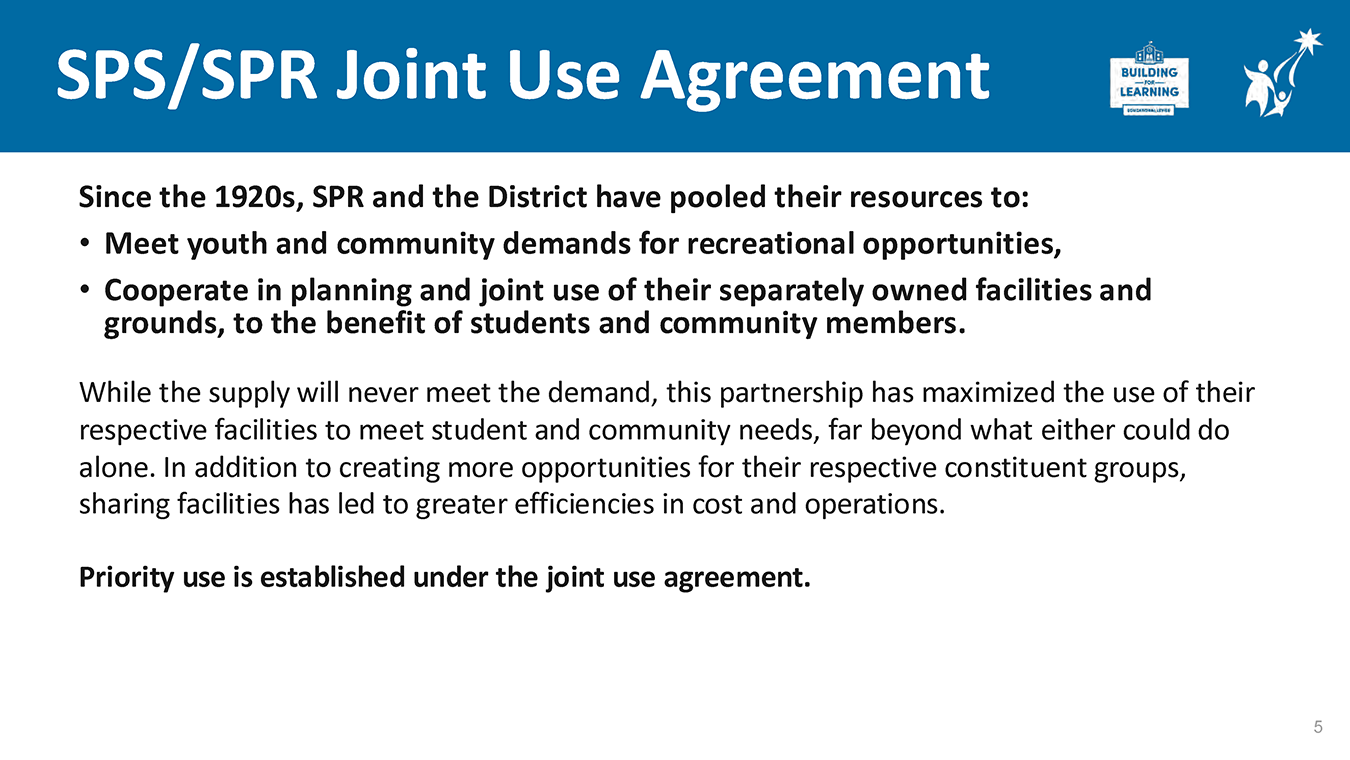
Slide titled ‘SPS/SPR Joint Use Agreement’ describing the long‑standing partnership between Seattle Public Schools and Seattle Parks and Recreation to share facilities for student and community recreation, with priority use defined under the agreement.”
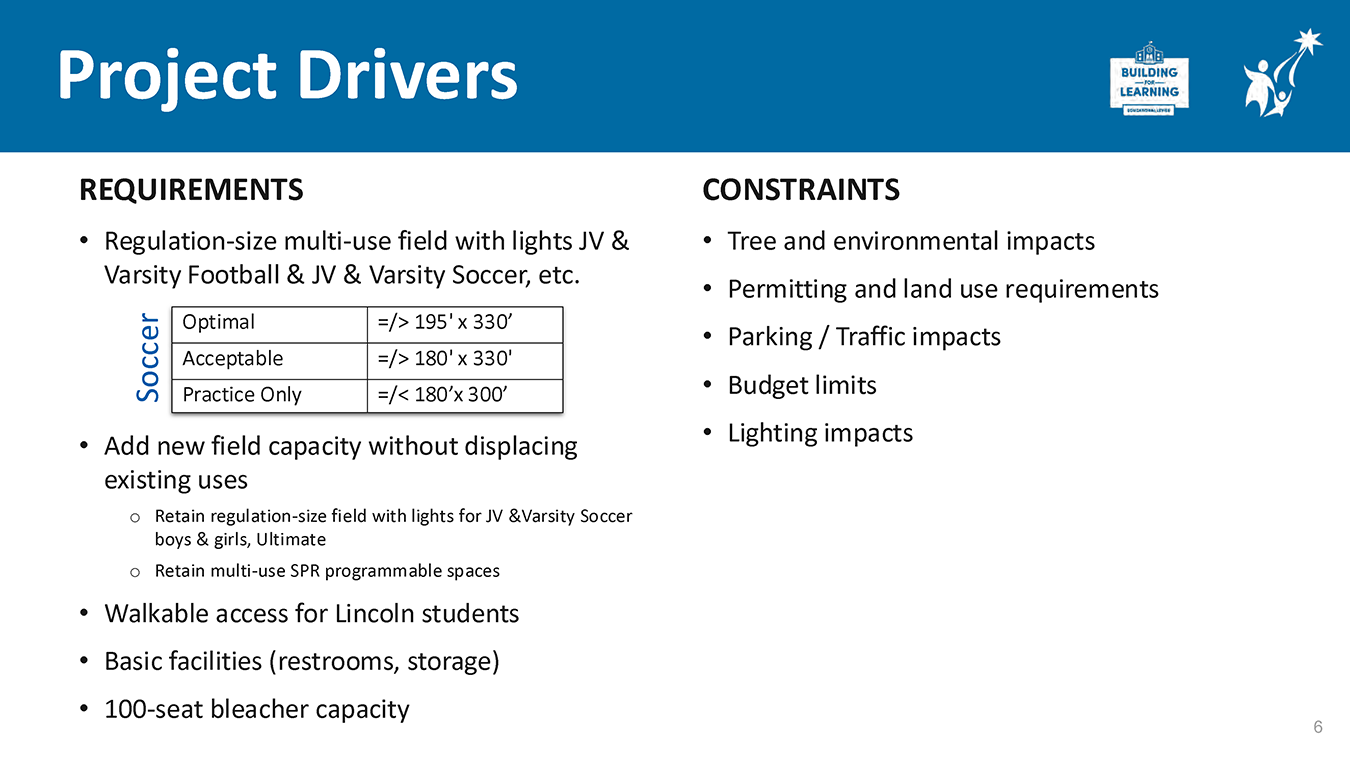
Slide titled ‘Project Drivers’ listing project requirements and constraints for a new multi‑use athletic field, including field size standards, added capacity, walkable access, basic facilities, environmental and permitting impacts, parking, lighting, and budget limits.
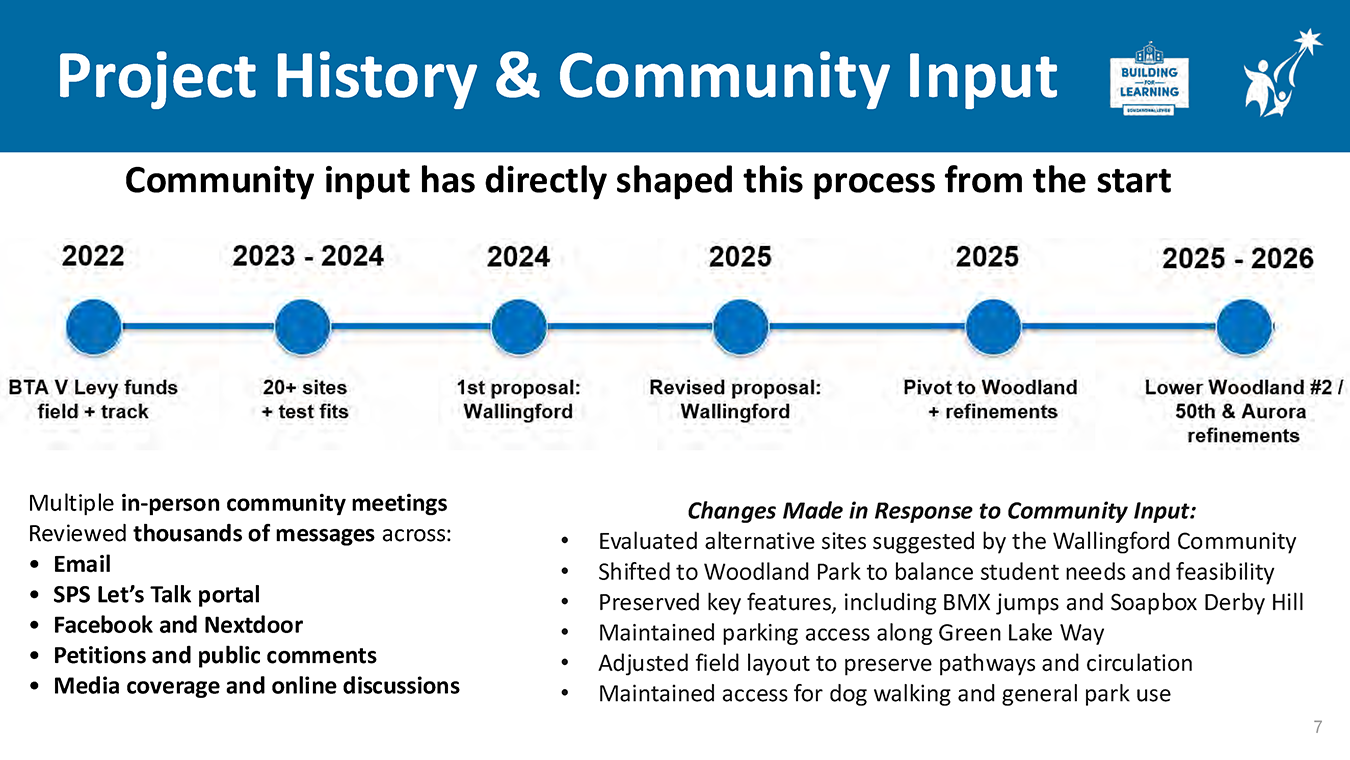
lide titled ‘Project History and Community Input’ showing a timeline from 2022 to 2026 demonstrating how community feedback shaped site selection and project changes, along with a list of outreach methods and resulting design adjustments.”
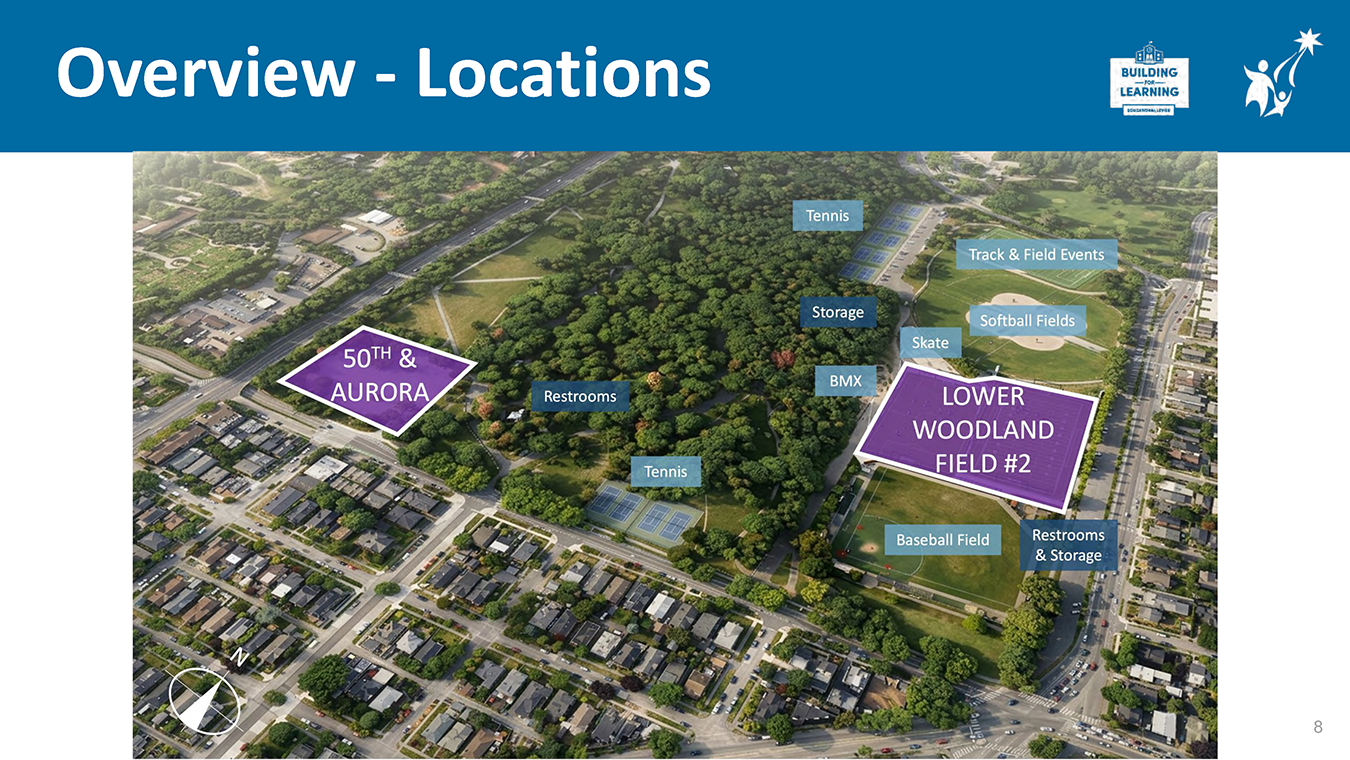
Aerial view of Woodland Park labeled to show two potential project areas: ‘50th and Aurora’ and ‘Lower Woodland Field #2,’ along with nearby amenities including tennis courts, restrooms, BMX area, skate area, softball and baseball fields, storage, and track and field facilities.
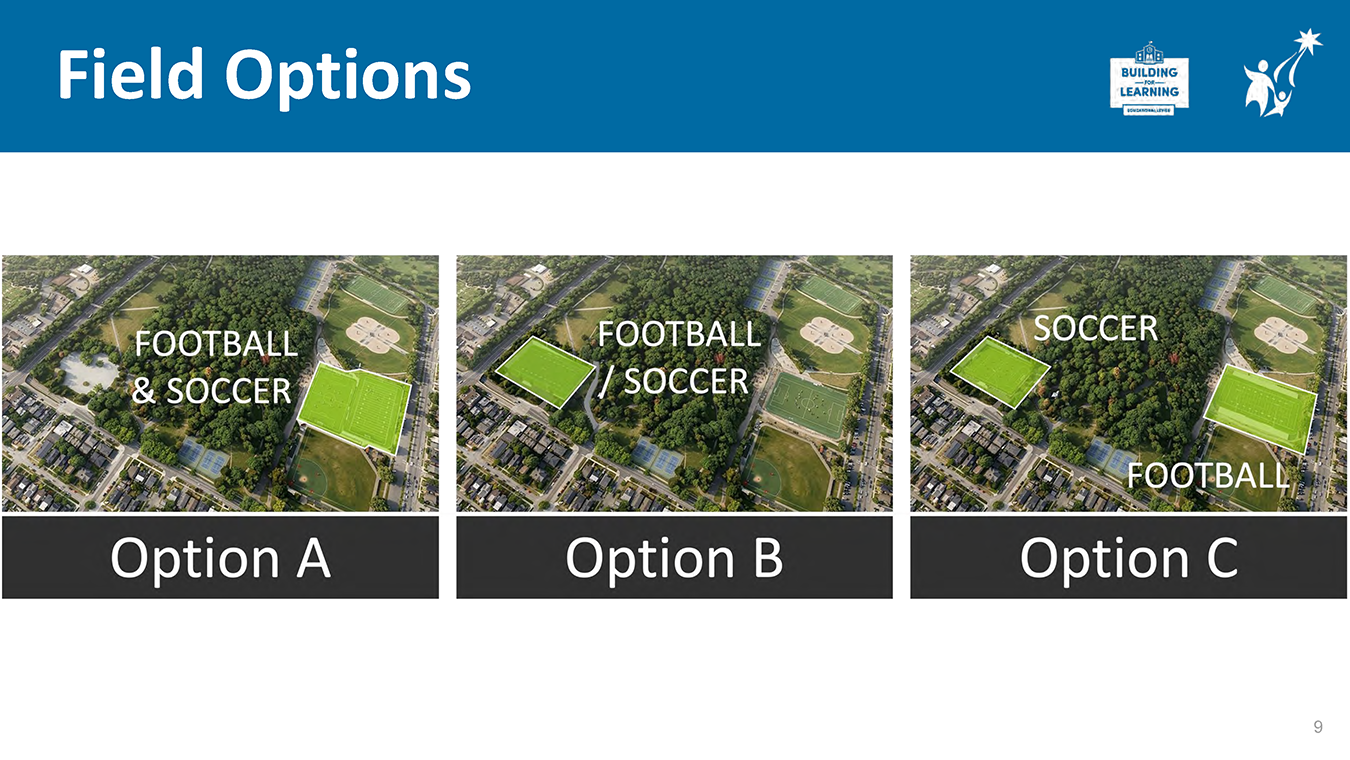
Slide titled ‘Field Options’ comparing three layout alternatives—Option A, Option B, and Option C—showing different placements for football and soccer fields within the park.”
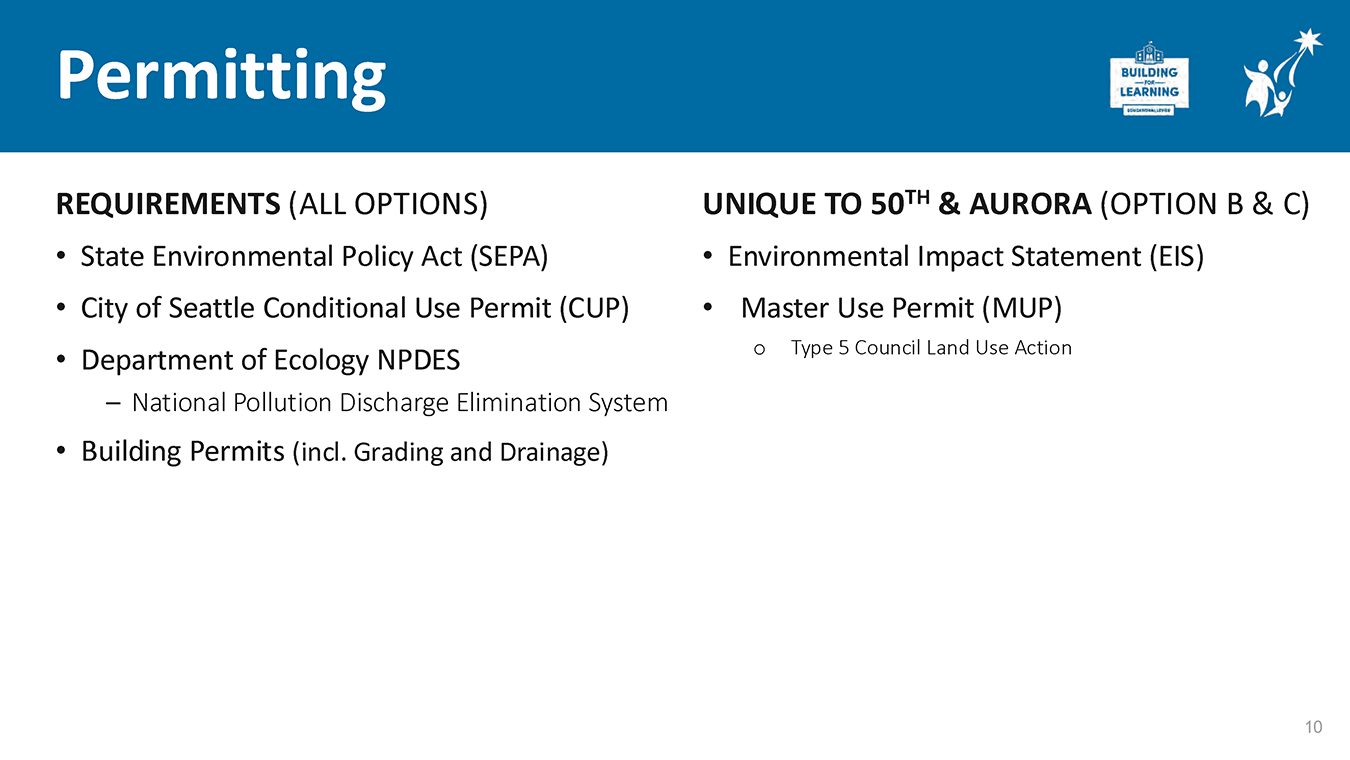
Slide titled ‘Permitting’ listing required permits applicable to all project options, including SEPA, City of Seattle conditional use permits, Department of Ecology NPDES permits, and building permits, with additional environmental impact and master use permit requirements specific to the 50th and Aurora options.
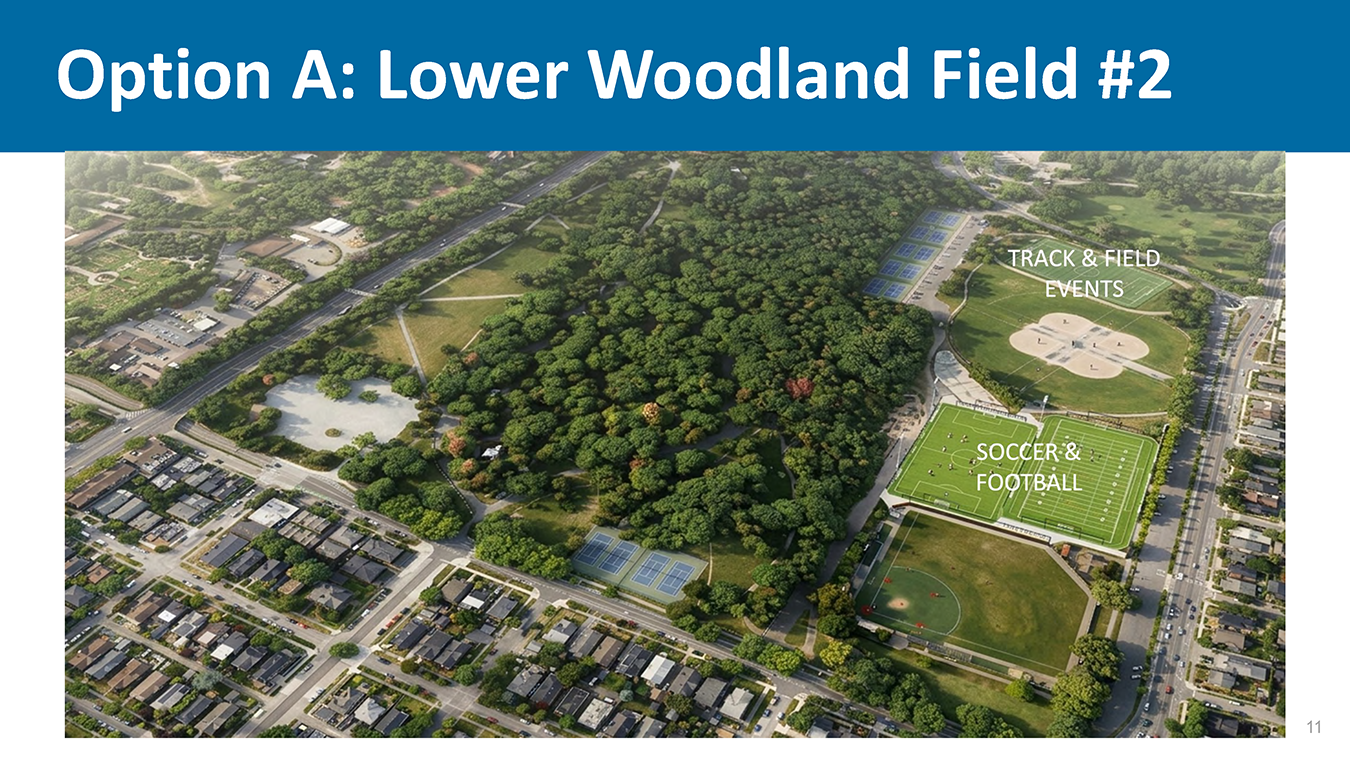
Aerial rendering of Lower Woodland Field #2 illustrating Option A, showing proposed soccer and football fields adjacent to existing track and field event areas within Woodland Park.
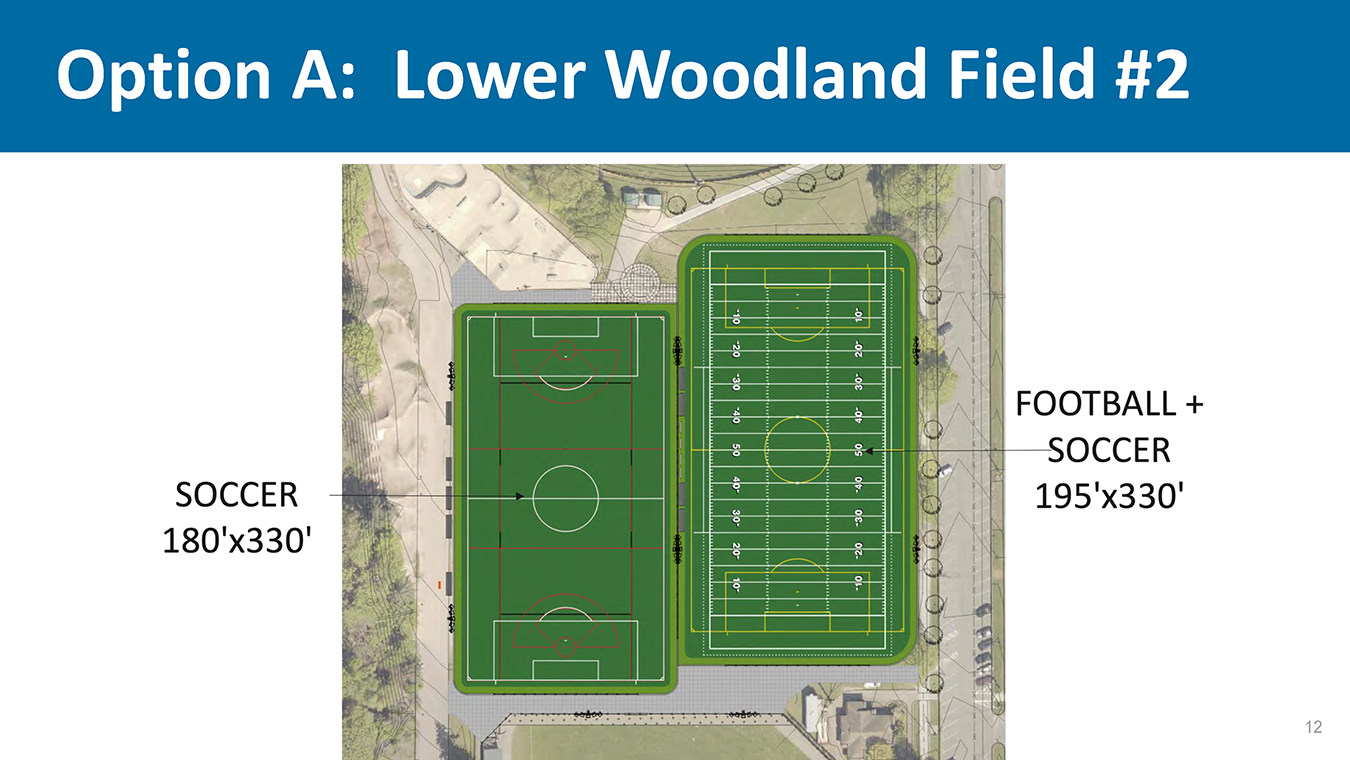
Plan view diagram for Option A at Lower Woodland Field #2 showing two adjacent fields: a soccer field measuring approximately 180 by 330 feet and a combined football and soccer field measuring approximately 195 by 330 feet.
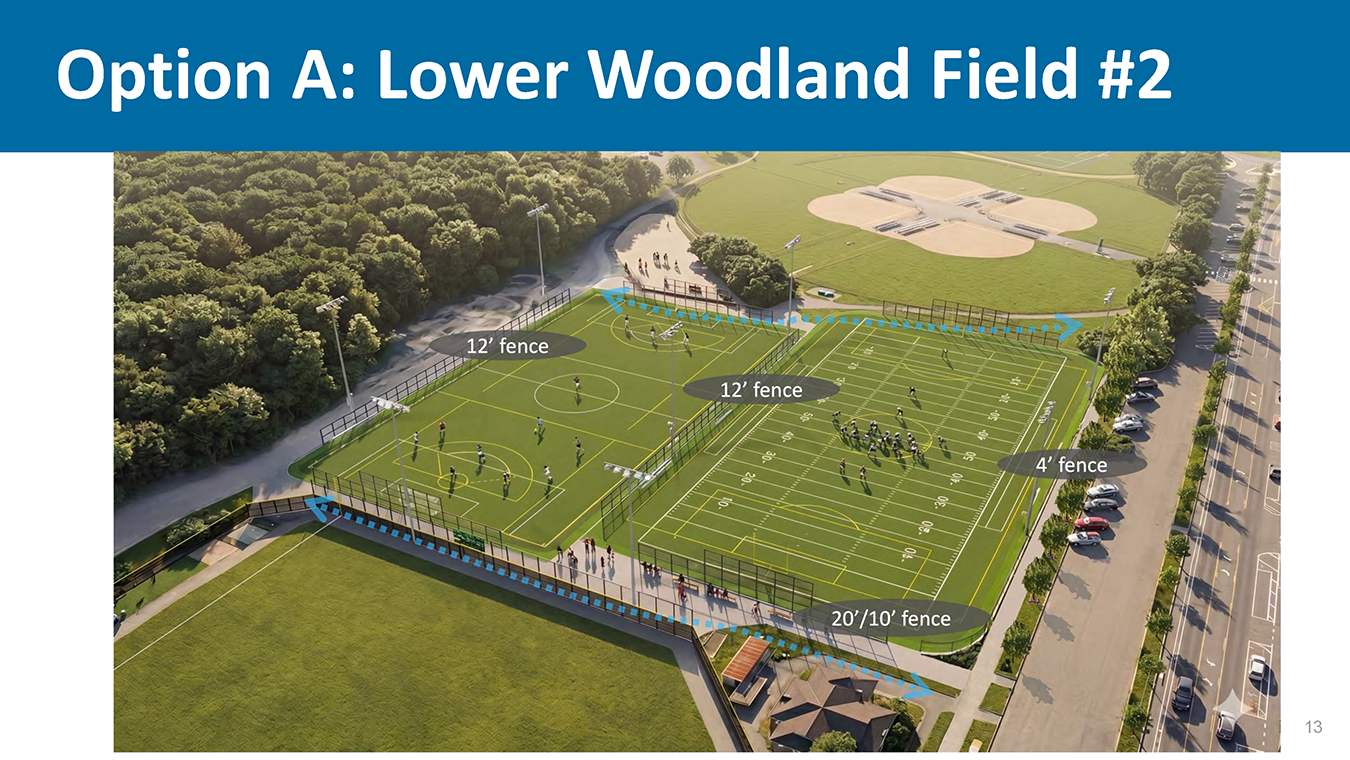
Rendered aerial perspective of Option A at Lower Woodland Field #2 showing two adjacent athletic fields in use, with labeled fencing heights around the perimeter and between fields, pedestrian pathways, and nearby park amenities including existing track and field areas.
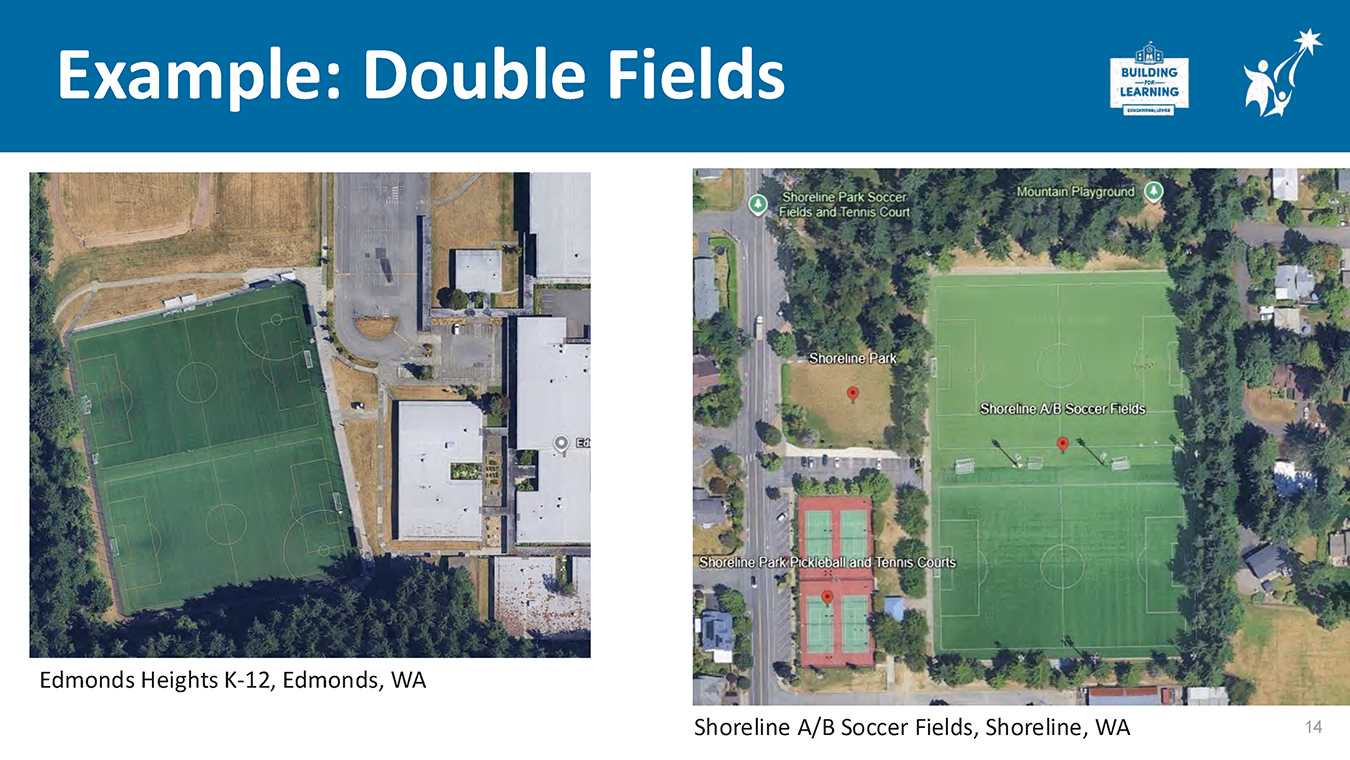
Slide titled ‘Example: Double Fields’ showing two aerial reference images of athletic facilities in Edmonds and Shoreline, Washington, each illustrating side‑by‑side soccer fields within a school or park setting.
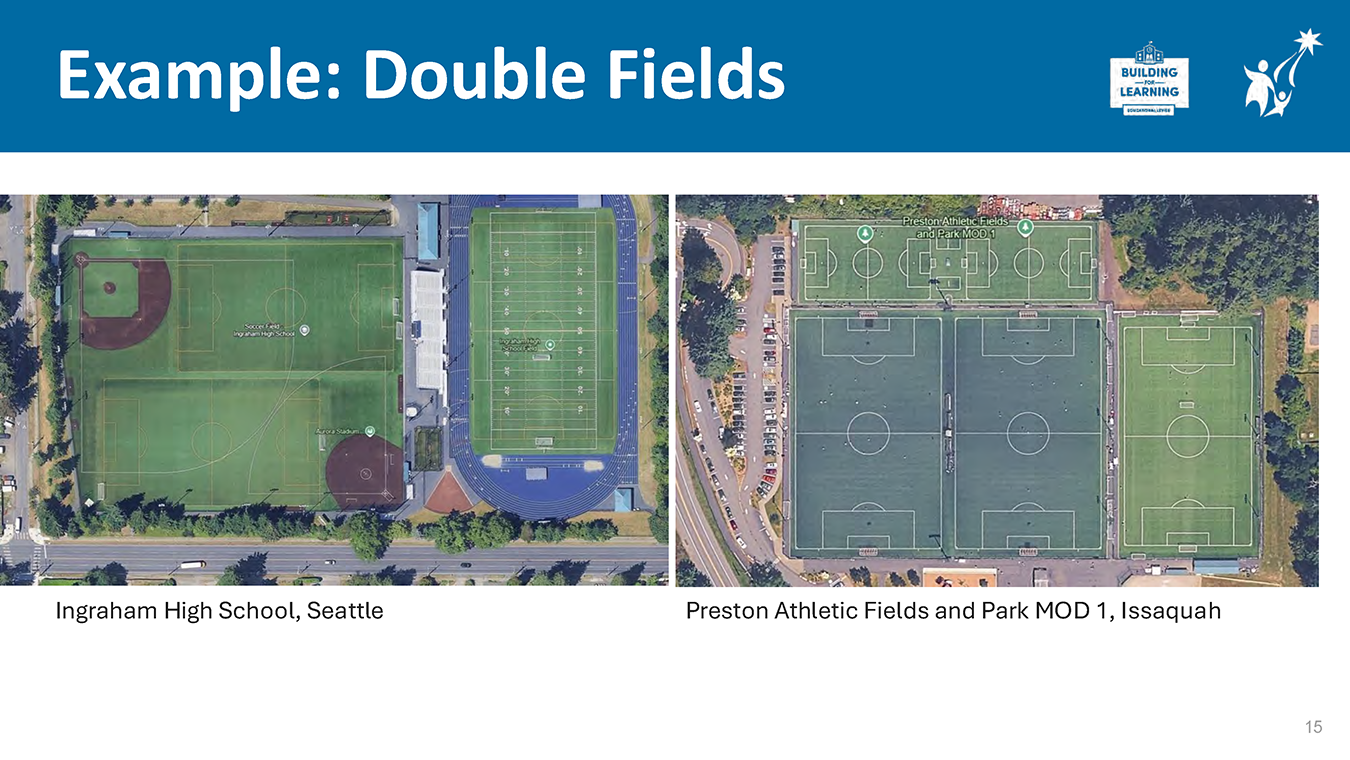
lide titled ‘Example: Double Fields’ showing aerial views of athletic complexes at Ingraham High School in Seattle and Preston Athletic Fields in Issaquah, demonstrating multiple adjacent rectangular sports fields within developed sites.
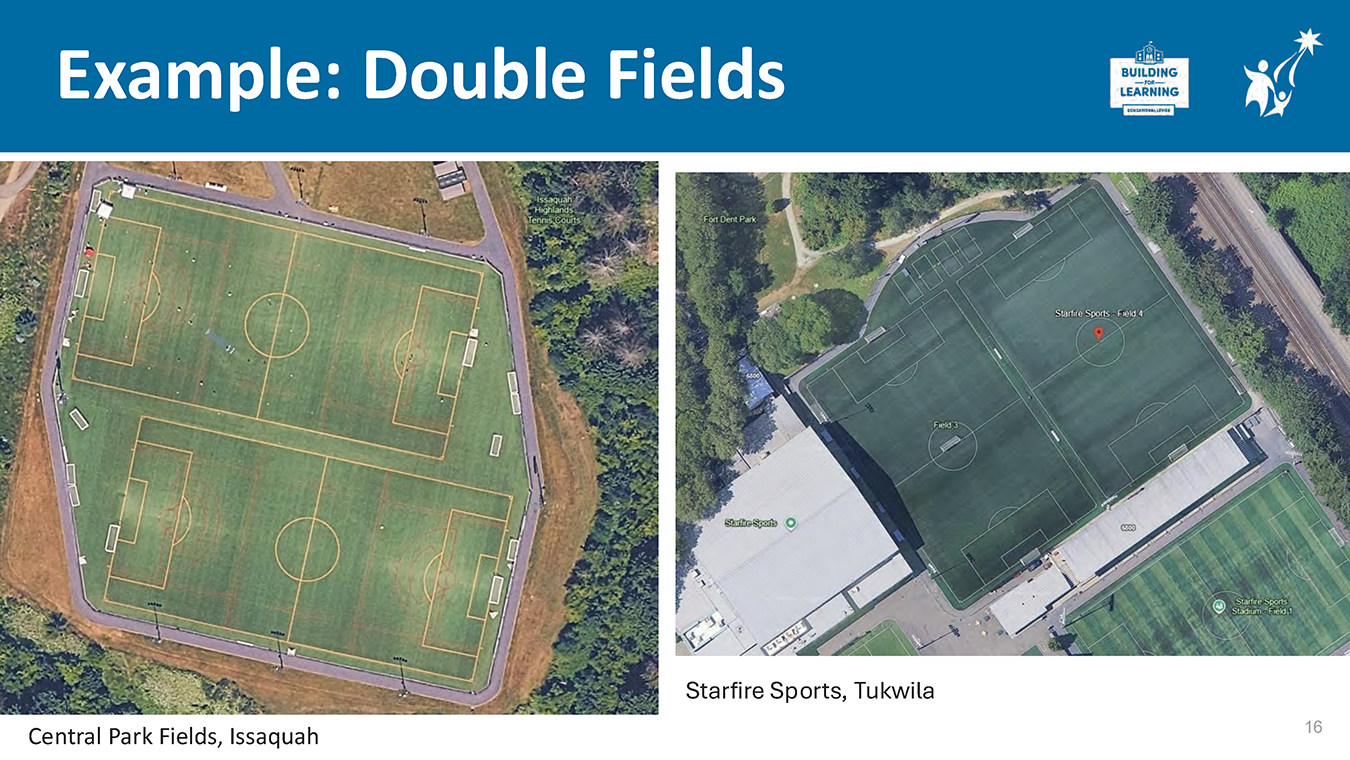
Slide titled ‘Example: Double Fields’ showing two aerial reference images: Central Park Fields in Issaquah and Starfire Sports in Tukwila, each illustrating adjacent rectangular athletic fields within park or sports complex settings.
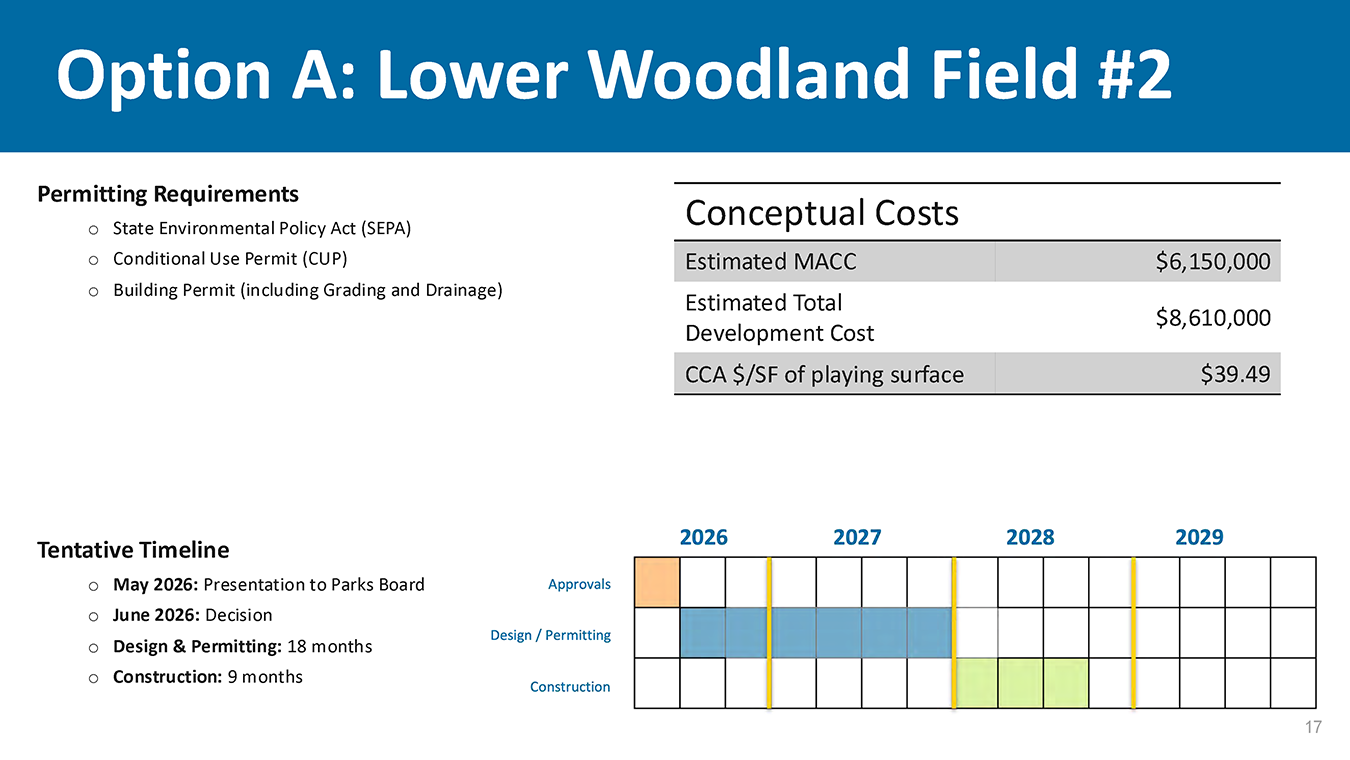
Slide titled ‘Option A: Lower Woodland Field #2’ summarizing permitting requirements, conceptual cost estimates, and a tentative multi‑year project timeline showing approvals, design and permitting, and construction phases.”
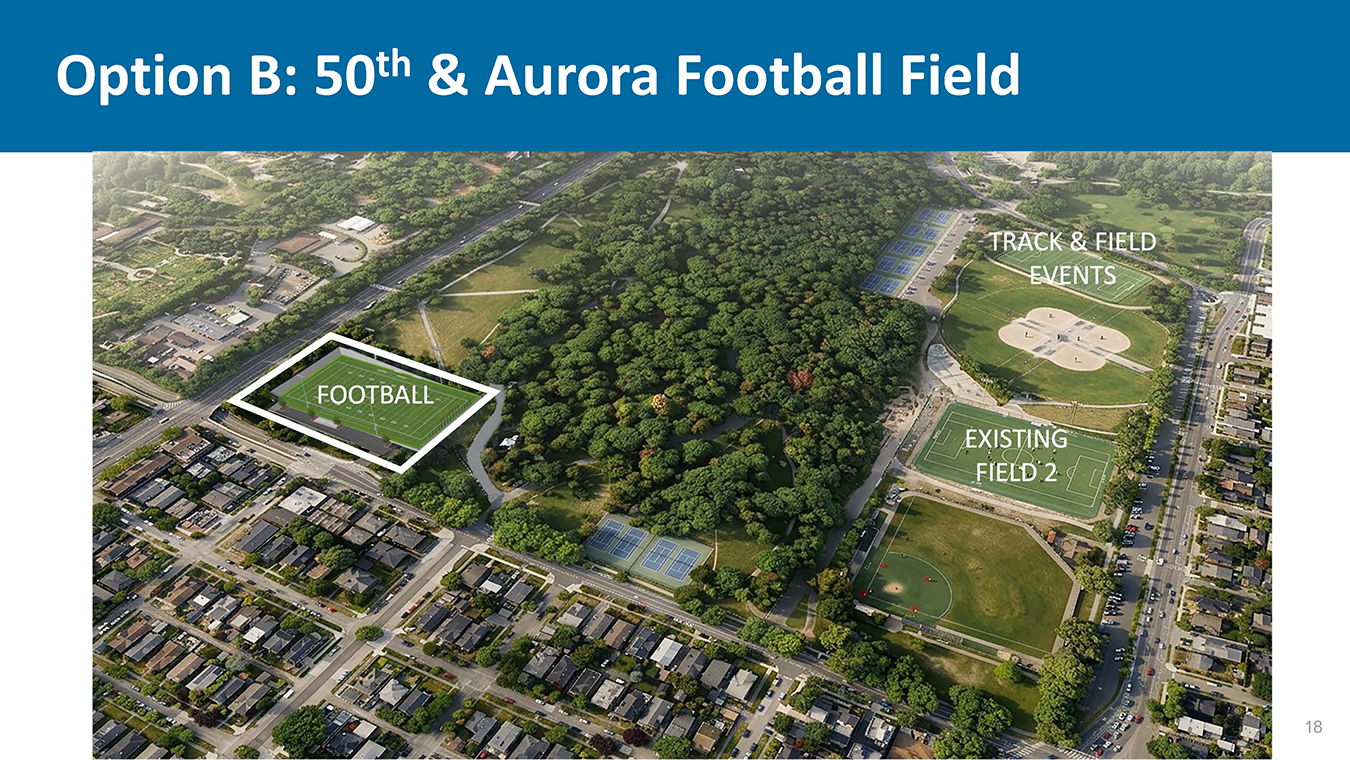
Rendered aerial view of Option B at 50th and Aurora showing a proposed football field site highlighted near surrounding residential streets, with existing Lower Woodland athletic fields, track and field event areas, and park amenities visible nearby.
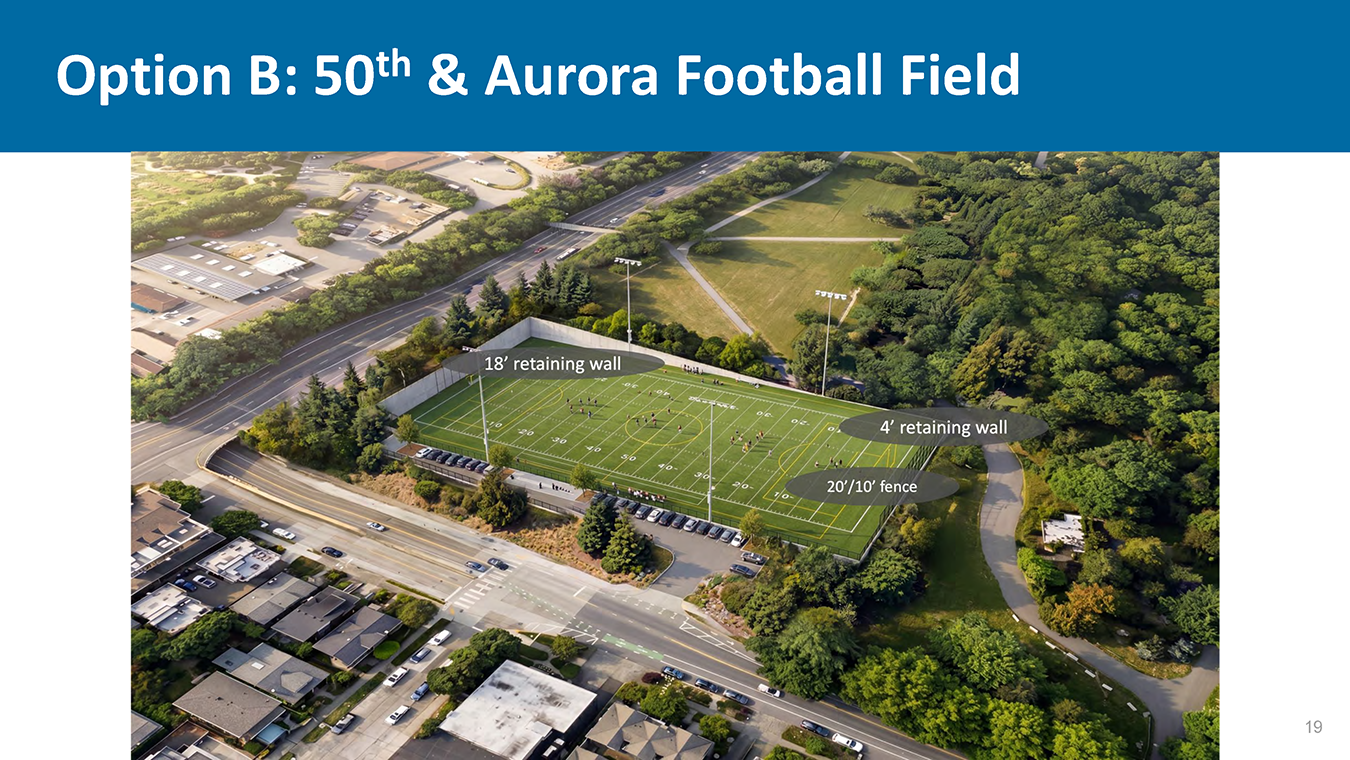
ered aerial perspective of Option B at 50th and Aurora showing a proposed football field within a wooded park setting, with labeled retaining walls, fencing, nearby roads, and surrounding pedestrian paths.
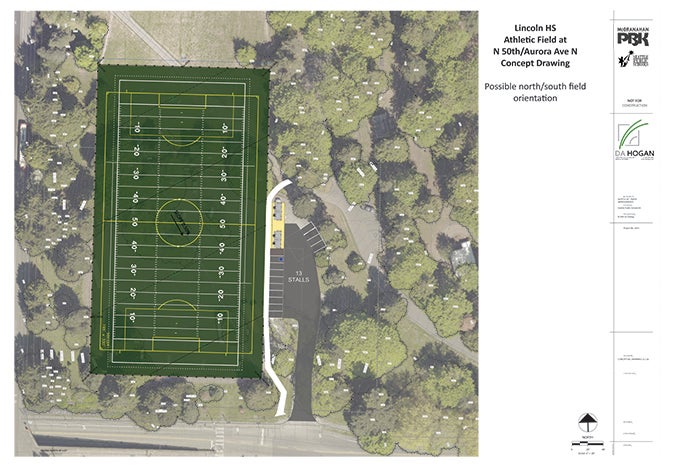
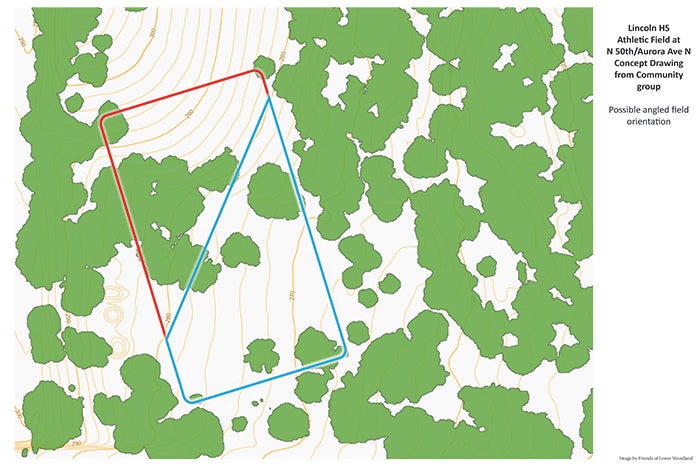
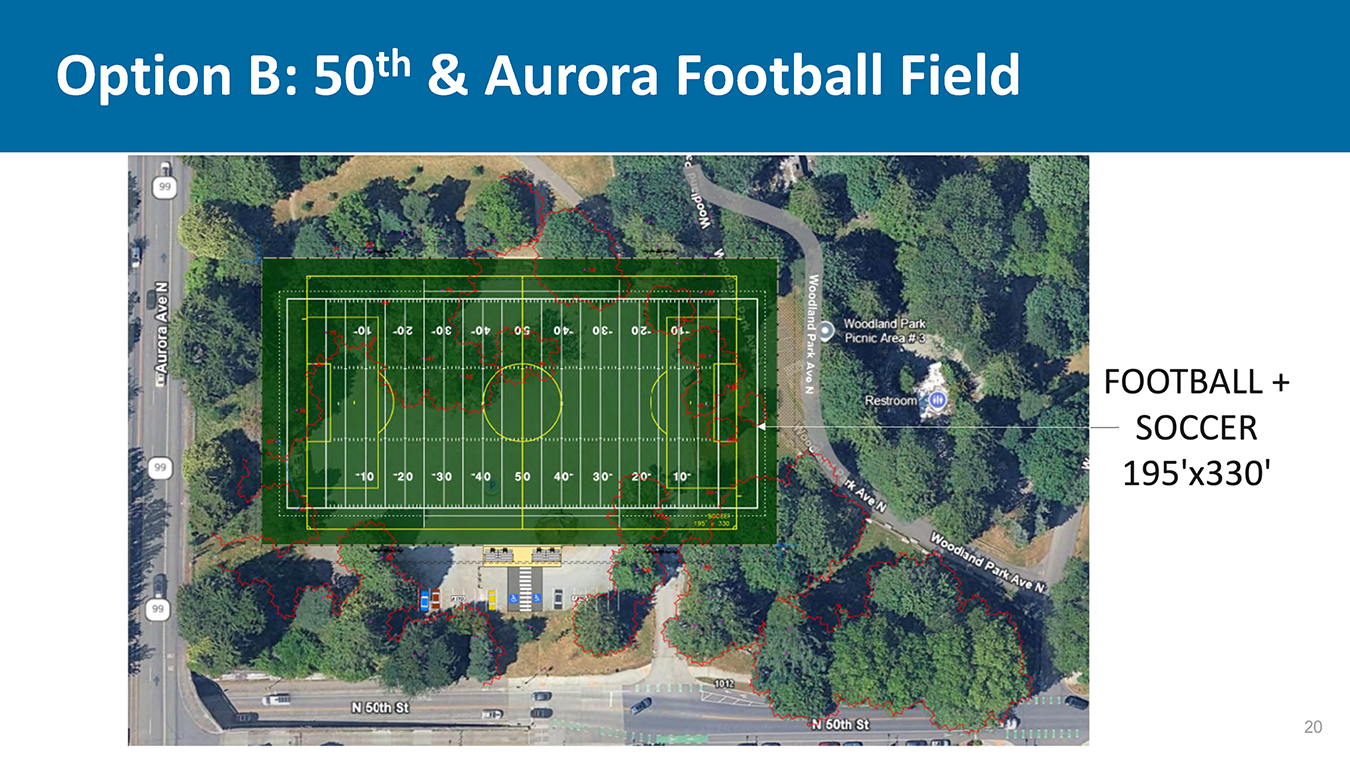
“Plan view diagram of Option B at 50th and Aurora showing a combined football and soccer field measuring approximately 195 by 330 feet, overlaid on an aerial map with surrounding streets, trees, and park features.
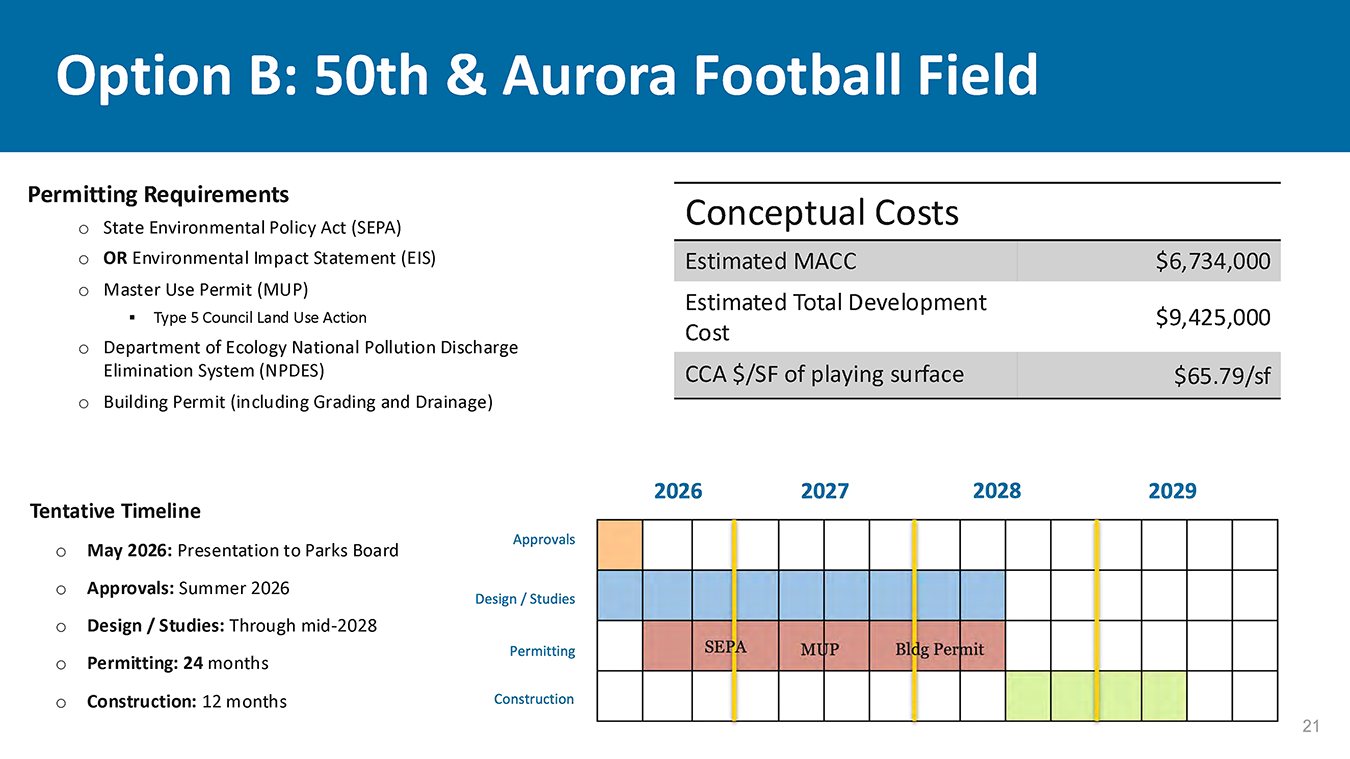
Slide titled ‘Option B: 50th and Aurora Football Field’ summarizing permitting requirements, conceptual cost estimates, and a multi‑year project timeline showing approvals, design and studies, permitting, and construction phases.
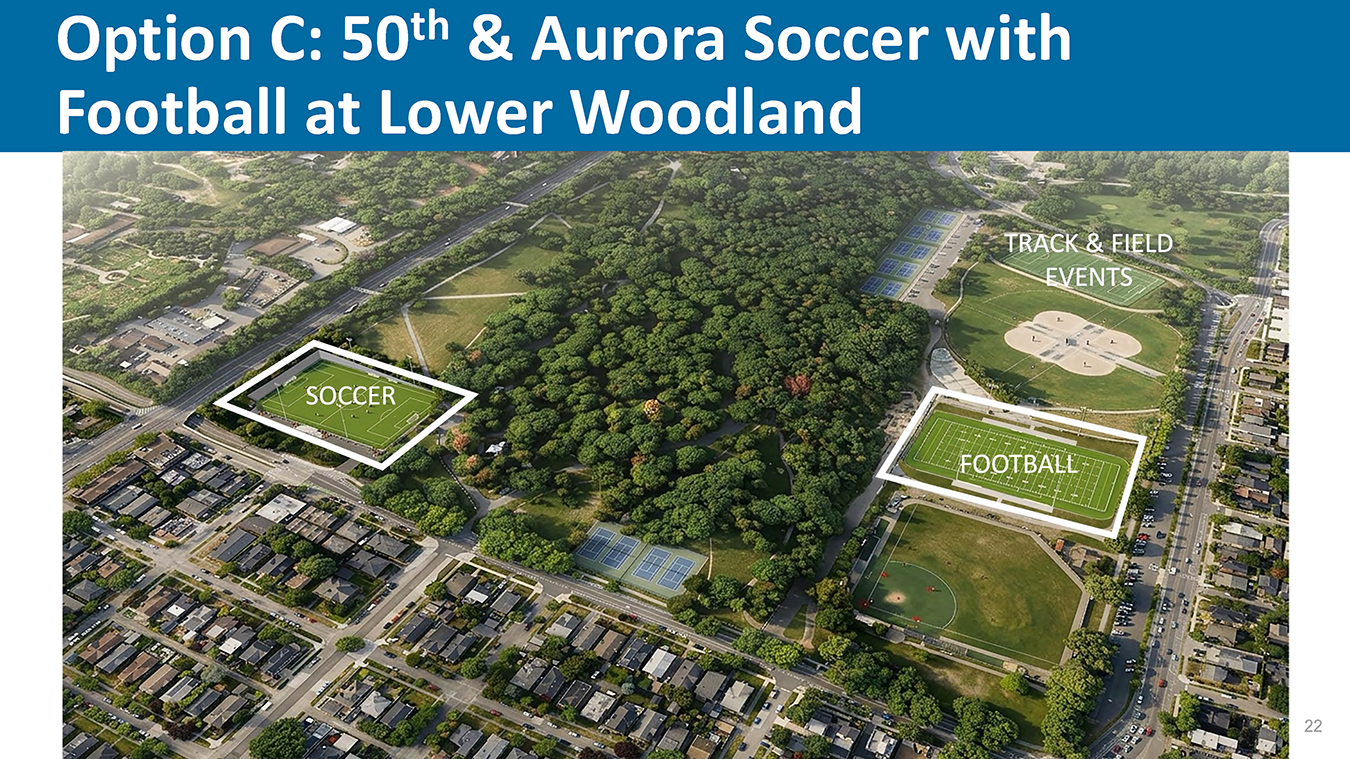
Rendered aerial view of Option C showing a proposed soccer field at 50th and Aurora and a football field at Lower Woodland, both highlighted within the broader Woodland Park area near existing track and field facilities.
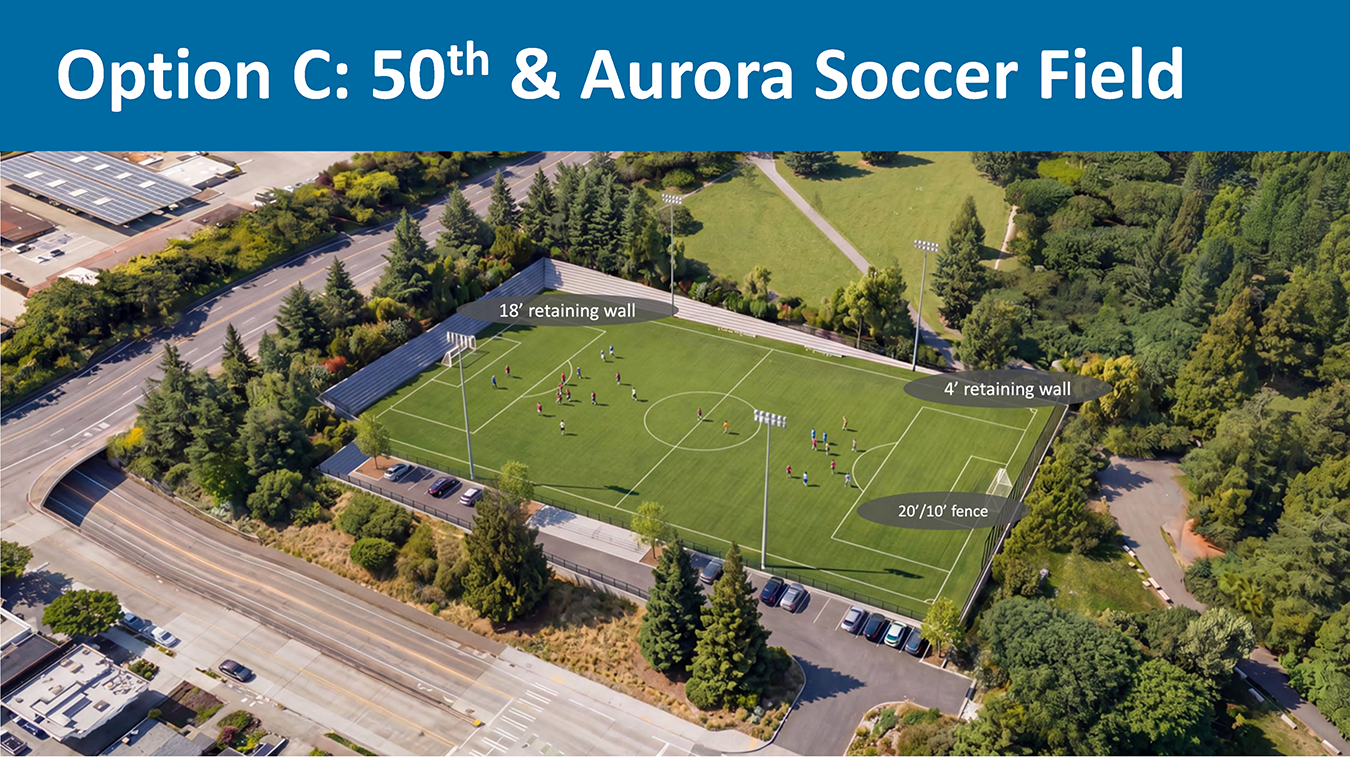
Rendered aerial perspective of the proposed soccer field at 50th and Aurora for Option C, showing labeled retaining walls, fencing, field lighting, adjacent trees, and nearby streets
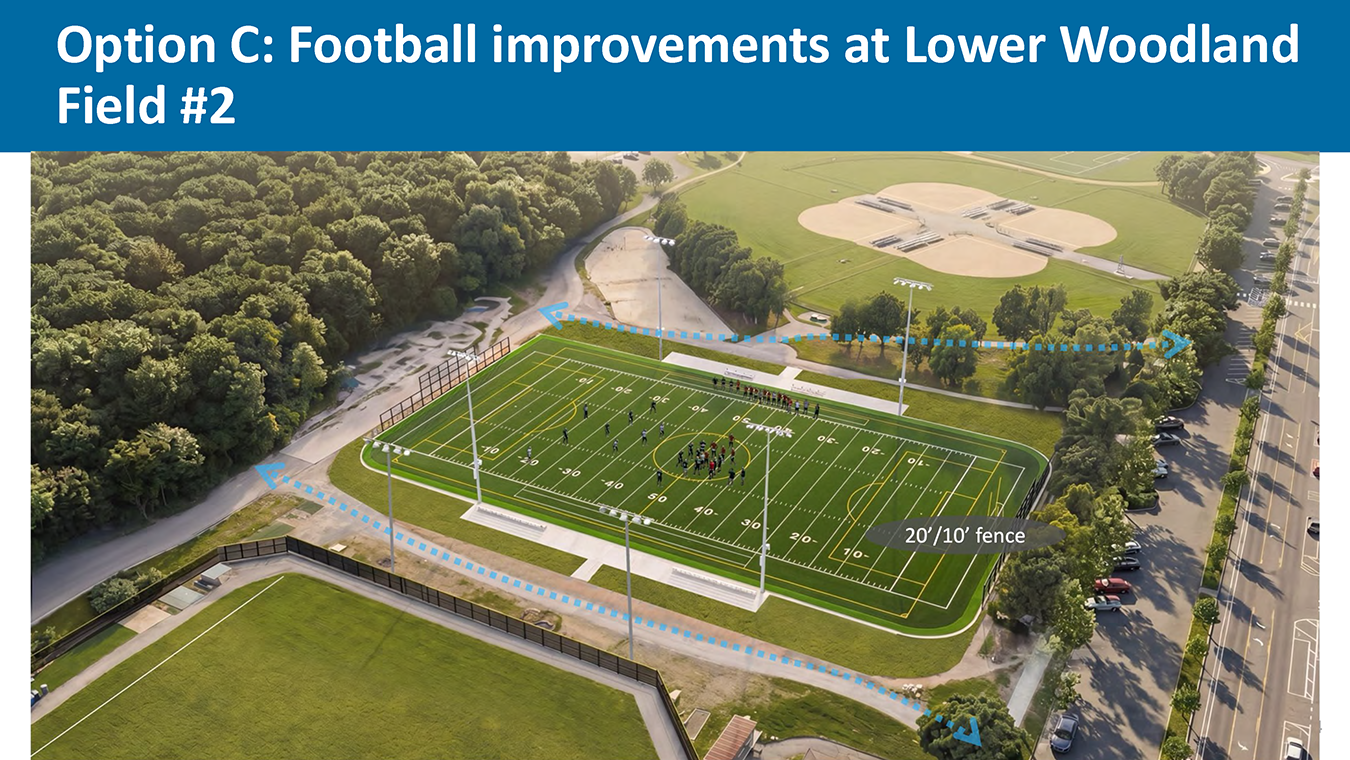
Rendered aerial view showing proposed football field improvements at Lower Woodland Field #2 for Option C, including fencing, field layout markings, and adjacent park pathways within Woodland Park.
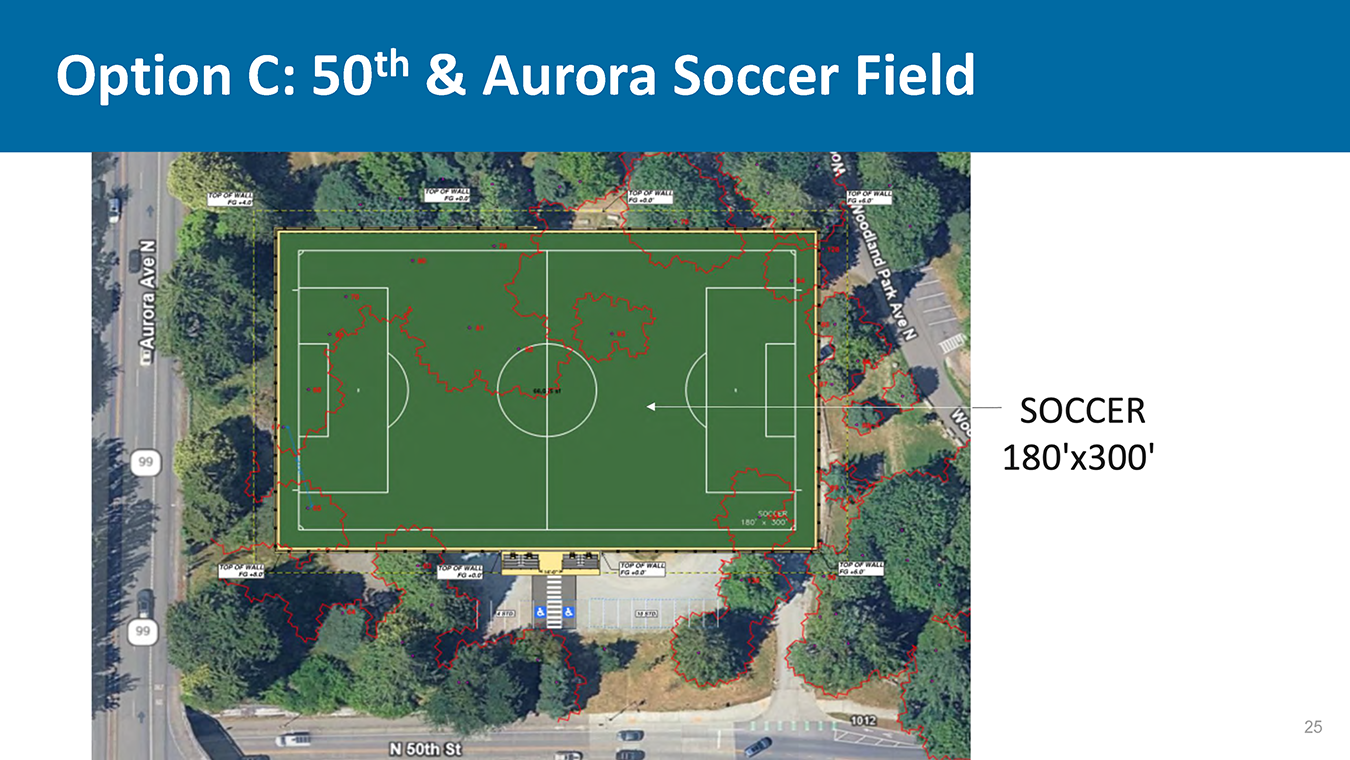
Plan view diagram for Option C showing a proposed soccer field at 50th and Aurora measuring approximately 180 by 300 feet, overlaid on an aerial map with surrounding streets, trees, and adjacent park features.
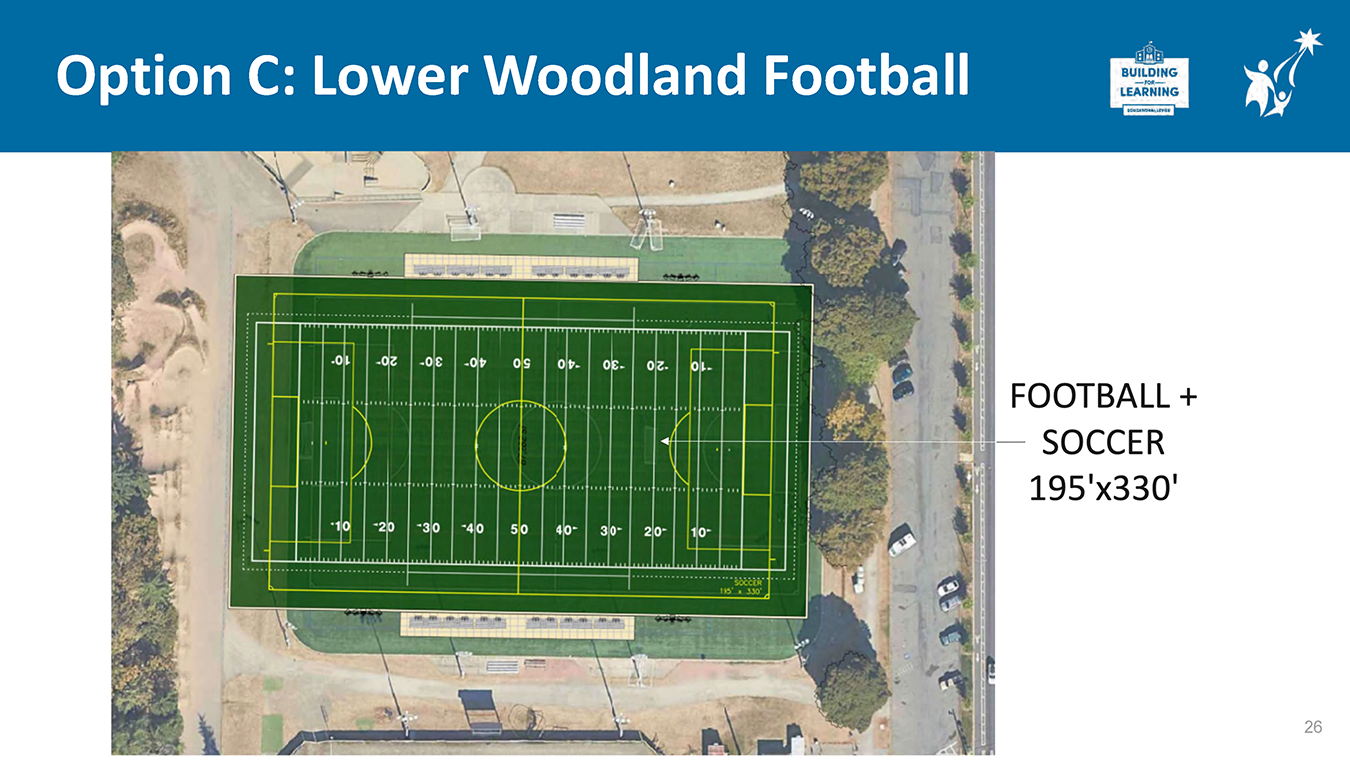
Plan view diagram for Option C at Lower Woodland showing a combined football and soccer field measuring approximately 195 by 330 feet, with field markings overlaid on an aerial view of the existing site and surrounding pathways.
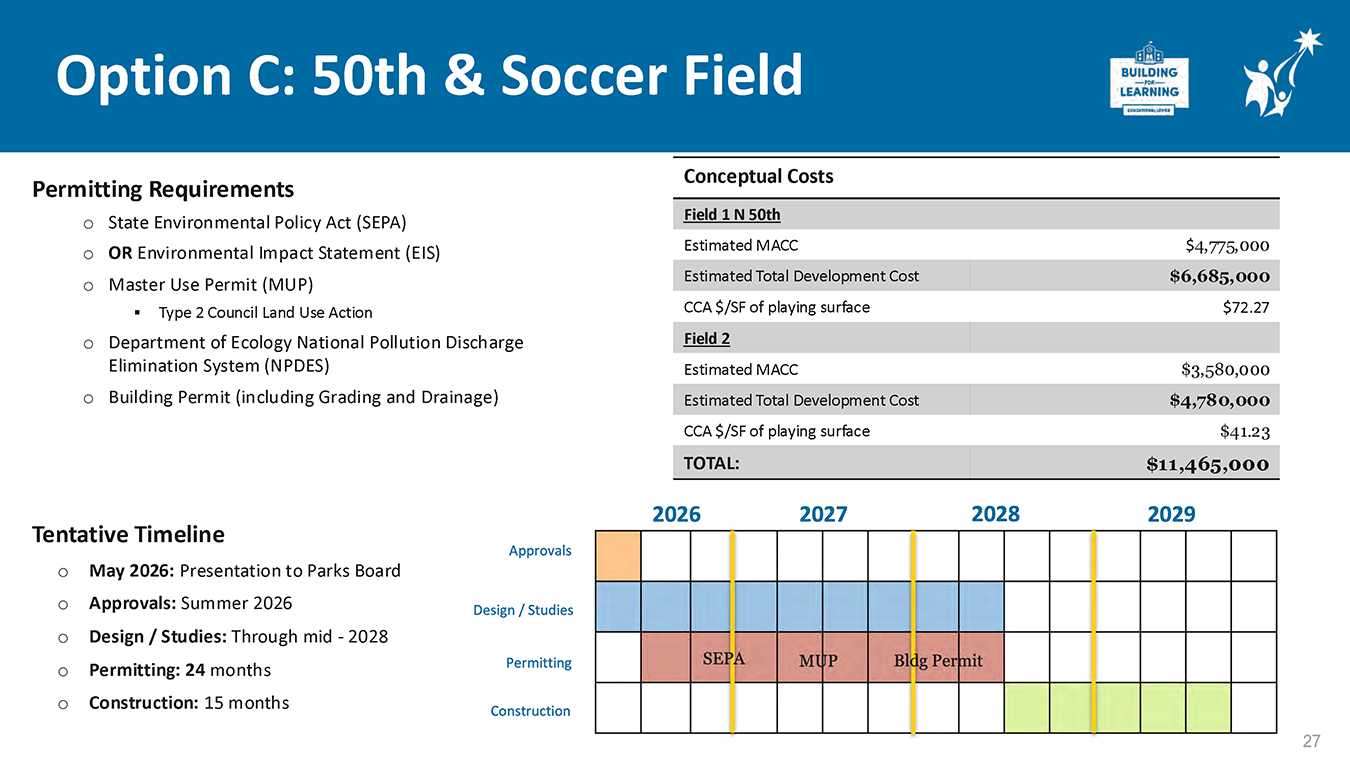
Slide titled ‘Option C: 50th and Soccer Field’ summarizing permitting requirements, conceptual cost estimates for two fields, and a tentative project timeline showing approvals, design and studies, permitting, and construction phases through 2029.
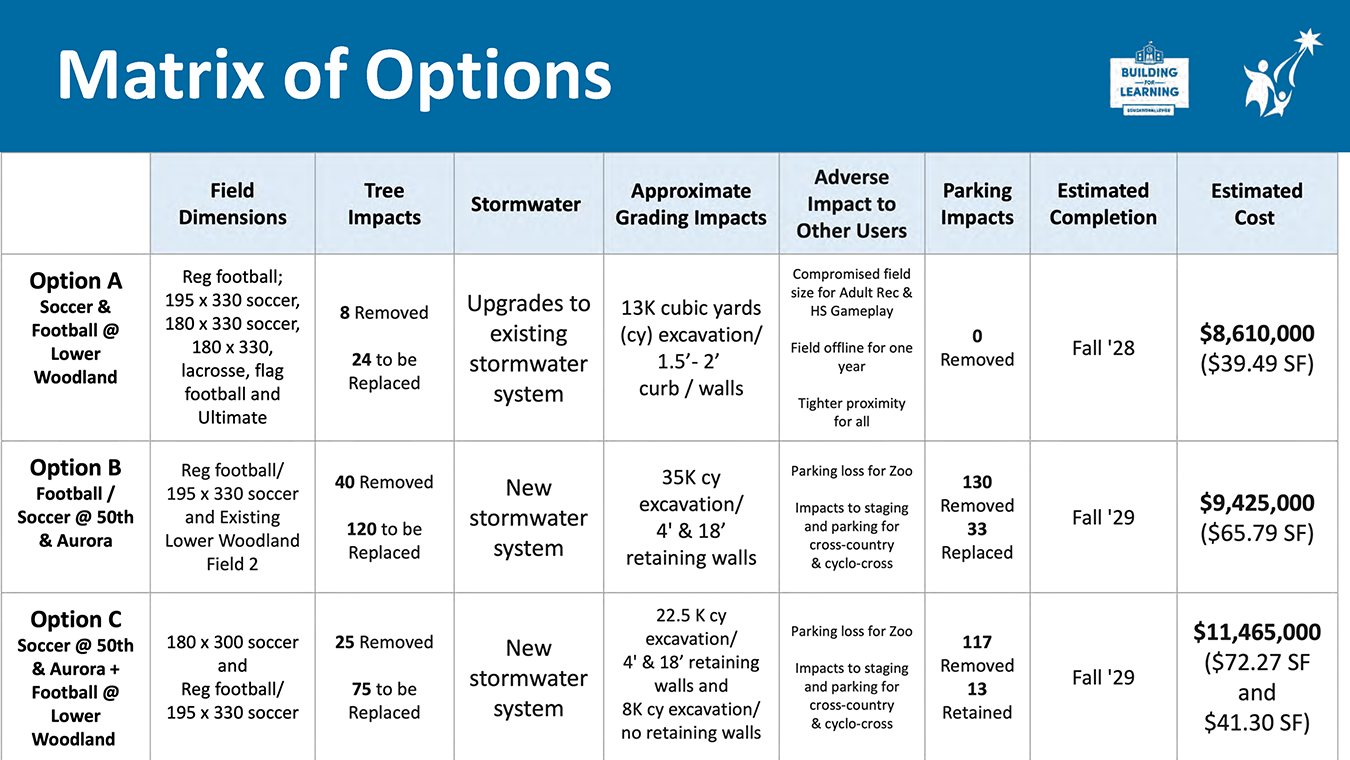
Table titled ‘Matrix of Options’ comparing Options A, B, and C across criteria including field dimensions, tree impacts, stormwater approach, grading impacts, effects on other users, parking impacts, estimated completion dates, and estimated costs.
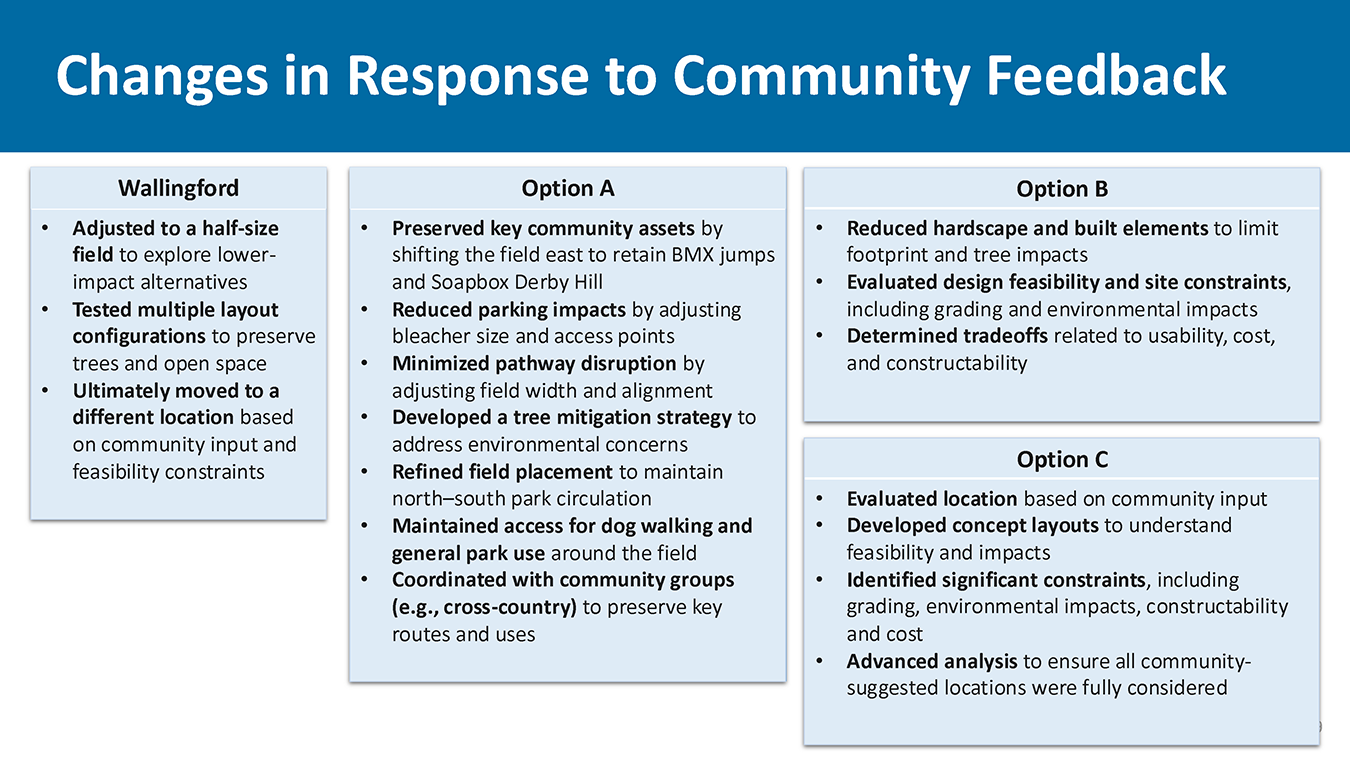
Slide titled ‘Changes in Response to Community Feedback’ summarizing design and site adjustments made for Wallingford, Option A, Option B, and Option C based on community input, feasibility analysis, and environmental considerations.
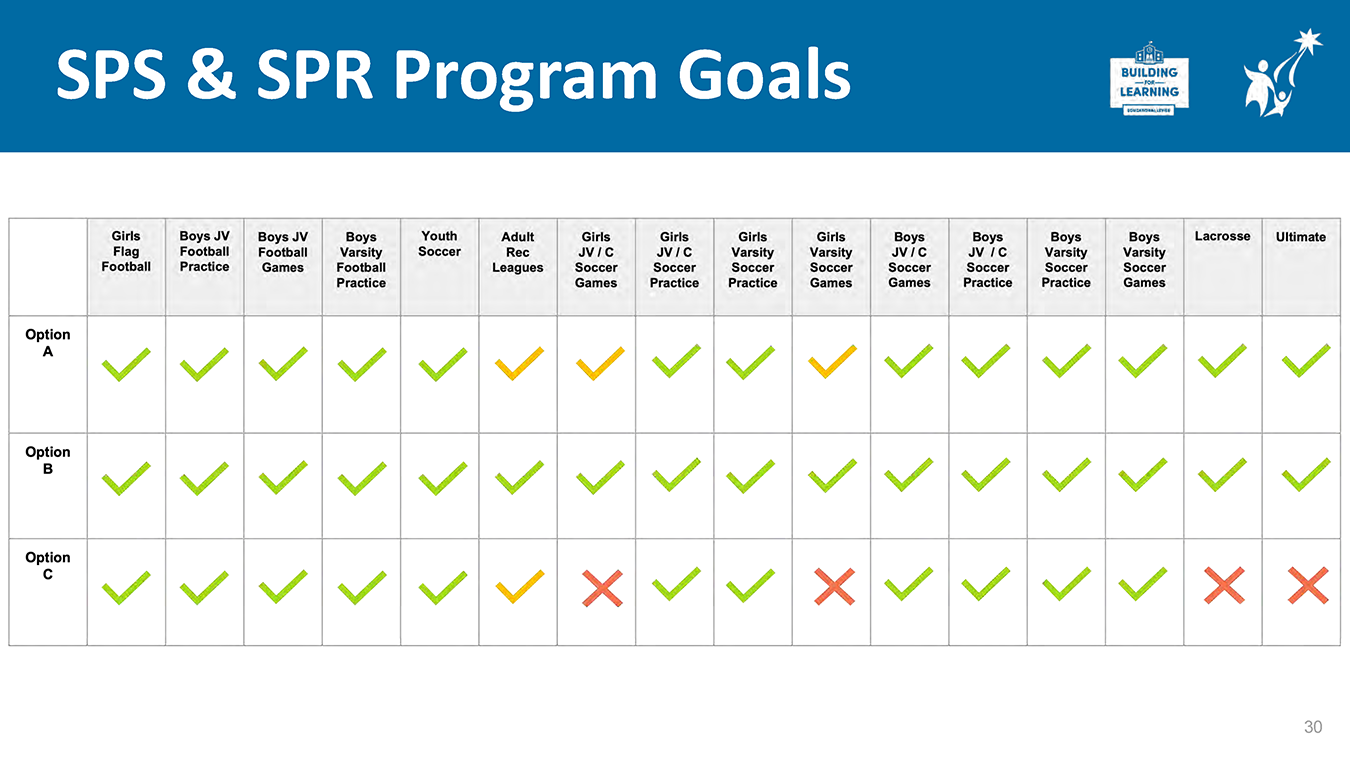
Table titled ‘SPS and SPR Program Goals’ showing which sports programs and uses are supported under Options A, B, and C, using check marks and X symbols to indicate compatibility across football, soccer, lacrosse, and ultimate programs.
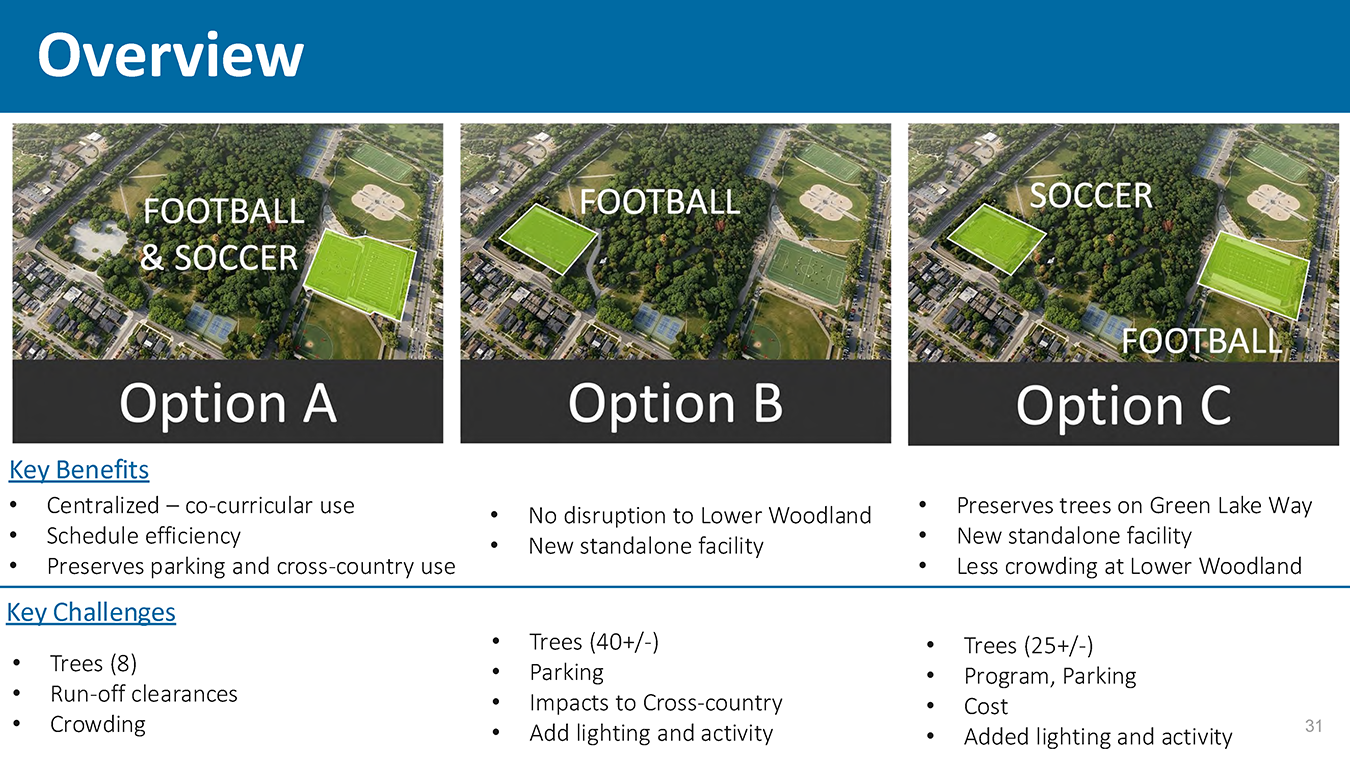
Overview slide comparing Options A, B, and C with aerial images highlighting field locations, along with bullet lists summarizing key benefits and key challenges for each option
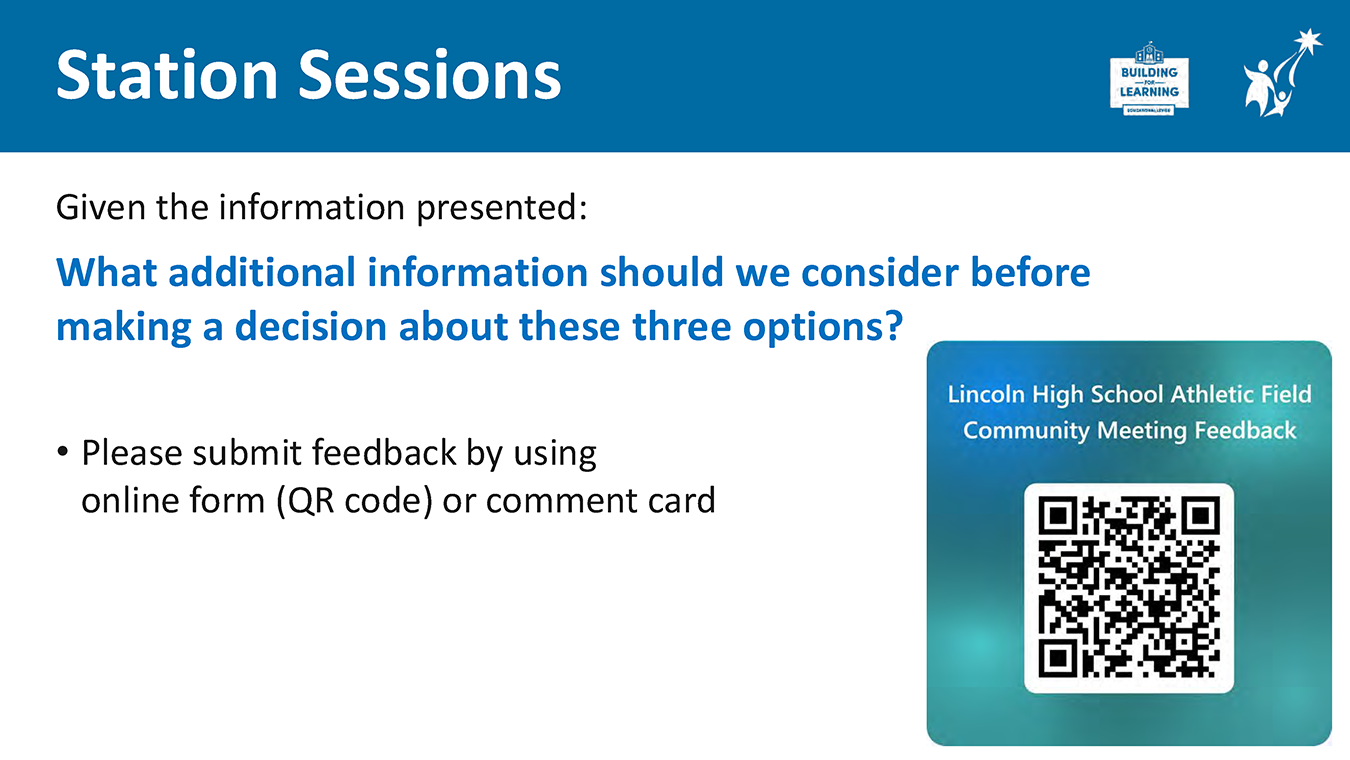
lide titled ‘Station Sessions’ asking what additional information should be considered before selecting among the three options, with instructions to submit feedback using an online form or comment card. + QR code linking to the Lincoln High School Athletic Field community feedback form.
Slide titled ‘Station Sessions: Report Out’ displayed over a close‑up image of an artificial turf field with yard line markings.
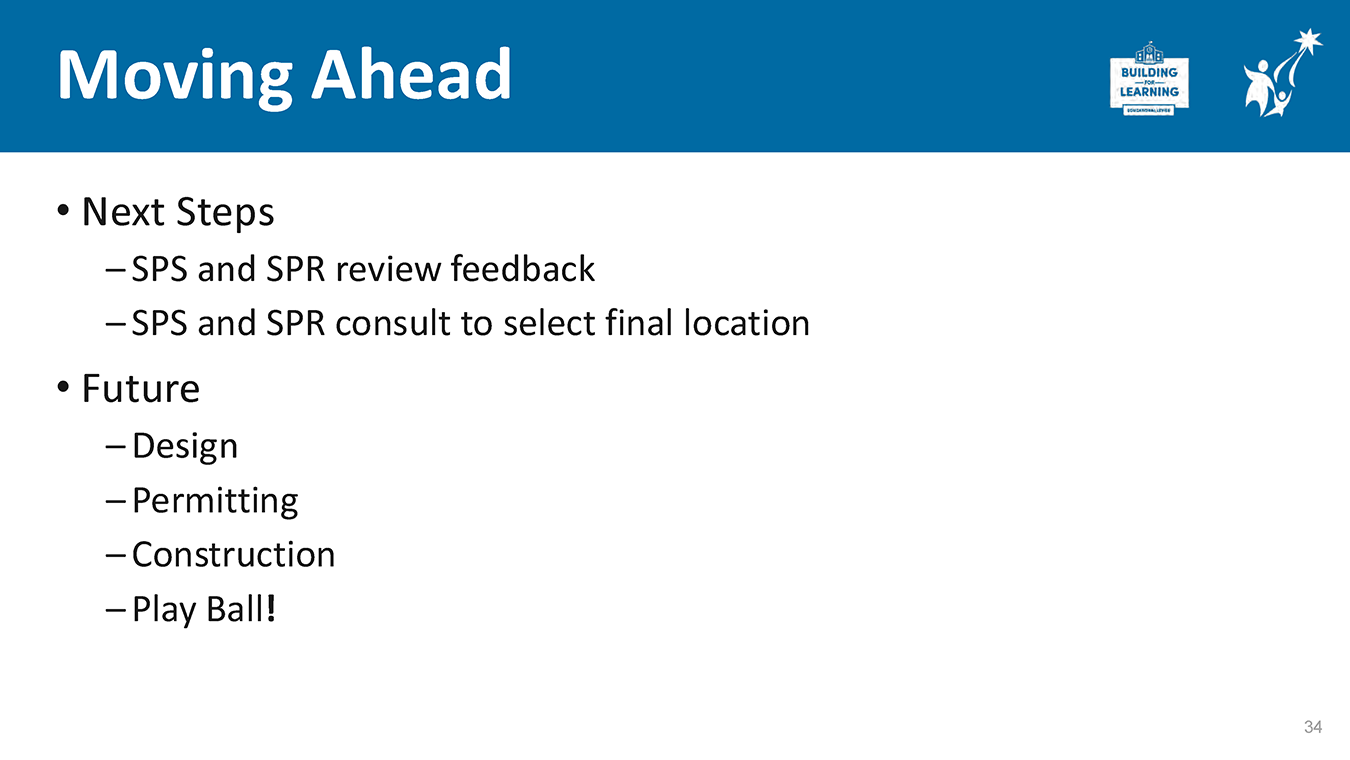
Slide titled ‘Moving Ahead’ outlining next steps, including reviewing community feedback and selecting a final location, followed by future phases of design, permitting, construction, and field use.
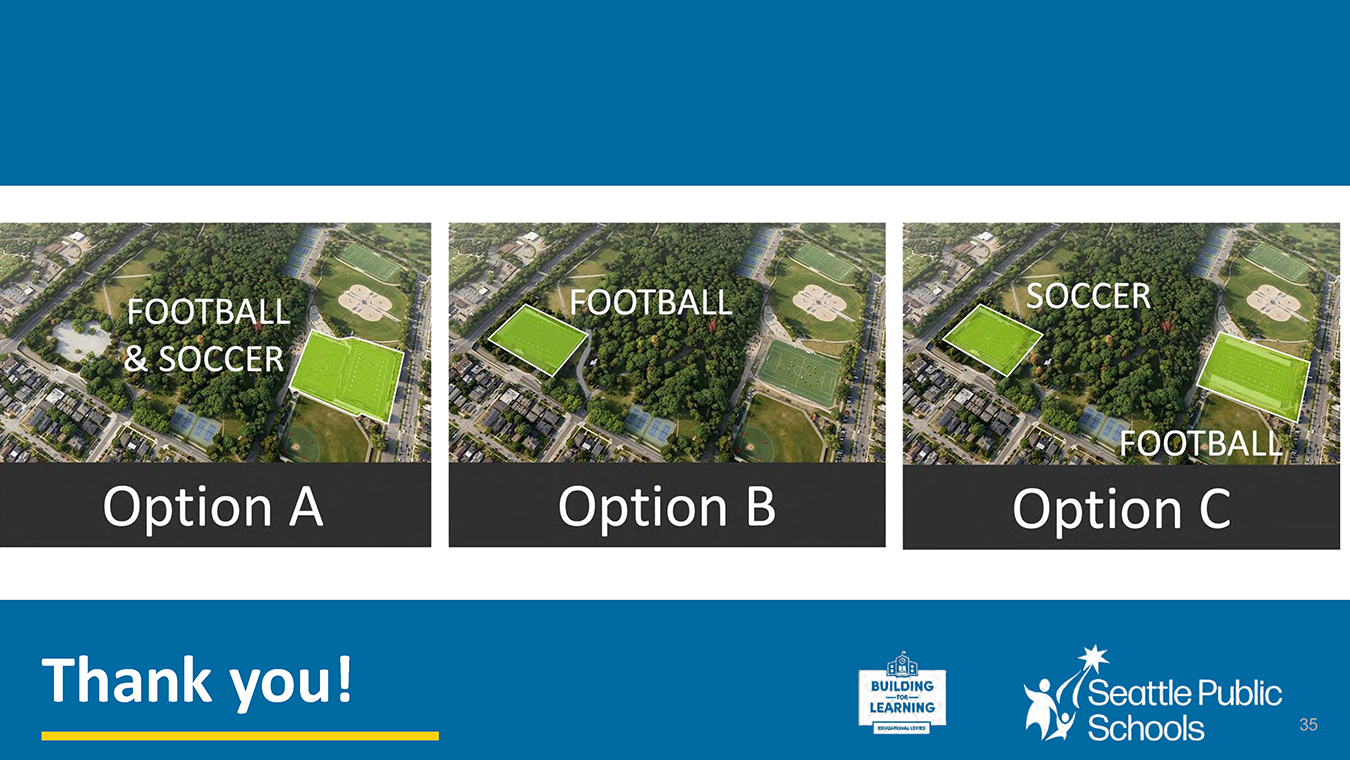
Closing slide reading ‘Thank you!’ with images comparing Options A, B, and C and logos for Seattle Public Schools and Building for Learning.

Meeting Video

Watch a recording of the meeting

Your Feedback Matters

If you attended the meeting, or if you have now viewed the presentation, please answer this question by May 9, by using our online form: What additional information should we consider before making a decision about these three options?

We will review all feedback and then consult with Seattle Parks & Recreation to make the final selection.

Community input has directly shaped this work. Over the past 3 years, we have heard from hundreds of people via email, the district’s Let’s Talk portal, community meetings, social media comments, petitions, news articles, and more.

FAQ for Meeting

What are you showing at the meeting on Saturday?

We will show evaluations of three field options: one at Lower Woodland Field #2 (Option A) and two options at the 50th and Aurora location (Option B and Option C).

Why do you need to add another field? It seems like the two soccer fields that are at Lower Woodland are often empty.

During the 3-month fall season and the 3-month spring season, both fields are booked to 100% capacity for use by youth and adult teams and by Lincoln teams.

What are the priorities for the new field?

  • The new athletic field needs to be within walking distance (half mile) from the school
  • It needs to be a new athletic field; any repurposing of an existing field would be displacing existing users
  • The athletic field needs to be a full-size with the ability to accommodate JV games for all girls’ and boys’ sports
  • The project needs to provide storage and restroom facilities

Have you done a study of “Option C”?

The project design team has spent extensive time on studying this option as well as Option A and Option B.

How much was included in the levy to pay for the new athletic field?

The 2022 Buildings, Technology, and Academics Capital Levy (BTA V) included $5 million for the project in 2022 dollars.

What are the cost estimates for each option?

Estimated total development costs:

  • Option A:         $8,610,000
  • Option B:         $9,425,000
  • Option C:         $11,465,000

How will you pay for the field if the full cost wasn’t included in the levy?

There are contingency funds in all capital levies that will help with some of the costs. The BEX V capital levy also included funding to develop natural grass athletic fields at Fort Lawton. Those fields were under consideration to provide relief for the use of Lower Woodland synthetic turf fields by Lincoln High School. The planned fields were contingent on redevelopment of Fort Lawton. Some of that funding could be re-programmed as it’s use is consistent with the initial intent.

Will the community be able to use the new athletic field?

Yes. Seattle Parks & Recreation (SPR) will continue to own any athletic fields within Woodland Park. The new field will be included in the joint operating agreement between Seattle Public Schools (SPS) and SPR.

What role does Seattle Parks & Recreation (SPR) play in this project?

SPR is a close partner to SPS in identifying potential locations and logistics for the athletic field. After this meeting, SPS will consult with SPR to make a final decision on the location of the new field.

Will there be bleachers or other seating at the field once a location is selected?

There will be portable bleachers to accommodate at least 100 spectators.

Have you done parking and traffic studies on these options? We have considered parking and traffic impacts in all our site evaluations. Formal parking studies will be conducted as part of the permitting process.

Athletic Field Project Criteria

Requirements

  • Walkable location from Lincoln High School
  • New field capacity (no displacement of current field use)
  • Regulation size play for high school JV boys’ and girls’ soccer, JV football
  • Basic facilities such as equipment storage and public restrooms

Constraints

  • Tree and environmental impacts
  • Permitting and land use requirements
  • Parking impacts
  • Budgetary constraints

About the Project

Lincoln High School is the only high school in the district without an athletic field or track. Funding to add these facilities were included in the voter-approved Buildings, Technology, and Athletics/Academics Capital Levy (BTA V) in 2022.

There is not room to add a track or athletic field on the Lincoln site, so SPS has been looking for alternative locations.

Funding

This project is funded by the Buildings, Technology, and Academics/Athletics Capital Levy (BTA V), which was approved by Seattle voters in 2022.

These funds cannot help the district close the budget gap. Funding from a capital levy must be used for the specified purposed. Capital levy project funding cannot be transferred to the general fund, which is the account where operations and staffing are budgeted.

Project Team

Project Management Firm: Shiels Obletz Johnsen (SOJ)

SOJ Project Manager: Paige McGehee, paigem@sojsea.com

Design and Engineering Firm: McGranahan PBK

Frequently Asked Questions on the Full-Size Athletic Field (prior to April 2026)

Lincoln High School is the only high school in the district without an athletic field or track, which limits opportunities for Lincoln’s students. For many students, after-school sports such as soccer, football, and track are a big part of their high school experience. The lack of facilities requires Lincoln students to travel to distant fields, disproportionately affecting students without access to reliable transportation.

The new athletic field would provide athletics “home field” for student athletics practice, giving them a state-of-the-art, full-size turf field for soccer, football and other field sports as well as restrooms, and storage for athletic equipment. A location closer to Lincoln reduces transportation and allows more flexibility for student schedules.

SPR is a close partner to SPS in identifying potential locations and logistics for building the track and the full-size athletic field. Collaboration will continue during design and construction.

Seattle Parks & Recreation will own any facilities built at Woodland Park. The athletic field will be added to the interlocal agreement between SPS and Seattle Parks & Recreation. This agreement provides SPS students with athletic facilities and allows those facilities to be used by the larger community outside of set school use.

The final decision will be made jointly between Seattle Parks & Recreation (SPR) and SPS, guided and informed by community input. It’s important for our communities to be heard — that’s why we’re looking for input and feedback.

Currently, JV and varsity football are practicing at Ingraham. In the spring, boys’ soccer will also practice at Ingraham. Because Ingraham’s teams have priority, they are scheduling practice around use by Ingraham teams. Other teams, such as baseball, girls’ soccer, softball, and flag football, use fields at Lower Woodland and sites around the area for both practice and games.

While Memorial Stadium is being replaced, Lincoln varsity home games are being played at the Northwest Athletic Center (located at Ingraham High School). Once Memorial Stadium re-opens, it will again be the home field for Lincoln varsity games.

Lincoln will continue to use Lower Woodland facilities for sports such as baseball, girls’ soccer, softball, and flag football Because Lower Woodland is booked to capacity, it cannot accommodate additional needs.

Other schools use their fields for practice and games, and many are booked to capacity. Any additional use by Lincoln students would displace other programs

Our updated test fit layout for Option A at Lower Woodland Field #2 ensures that the field will no longer impact the BMX bicycle jump area. Thank you to the many community members who provided insight into the importance of maintaining these jumps. The skate park will also remain in place.

If a site is selected, temporary construction impacts are expected but will be carefully managed. Some trails may have short-term closures, but detours and signage will maintain access whenever possible. SPS and SPR will communicate clearly about timelines, closures, and alternative options for recreation during construction.

Seattle Public Schools (SPS) will partner with Seattle Parks and Recreation (SPR) to evaluate any potential tree impacts using a holistic approach. Each tree will be assessed for its health, size, species, canopy coverage, and ecological role, with the shared goal of preserving as many trees as possible.

If tree removal is necessary, SPS and SPR will develop a mitigation and replanting plan that aligns with Seattle Parks’ environmental standards and the City’s Urban Forest Management Plan. Replacement requirements are determined by city regulations: three new trees must be planted for every tree removed on City-owned land. 

Yes. The full-size athletic field will provide space for both the school and the broader community. The new field will become part of the SPR inventory of fields that is part of the interlocal agreement between SPS and SPR.

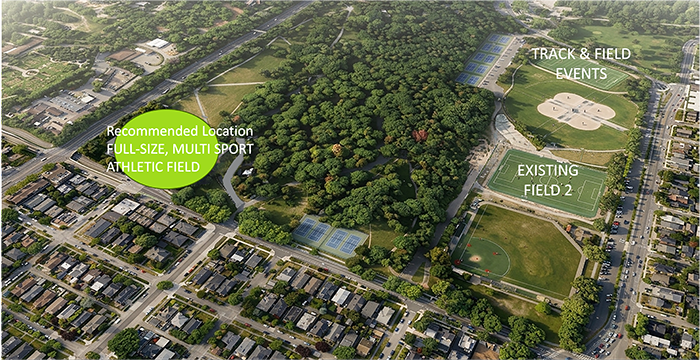
Locating the track and athletic field at Woodland Park will keep both facilities within the same park but not adjacent.

While we are studying locations at Woodland Park to potentially site the athletic field, we do not anticipate that there will be space for both a track and field.

We are planning upgrades to the track at Lower Woodland #7, but that field is not large enough to also include the new athletic field. In addition, upgrading the existing field would displace any athletic activities that currently take place on the field.

Lincoln’s campus footprint and existing parking lot size cannot accommodate a regulation full-size athletic field. While the parking lot site has been reviewed, it does not provide enough space to safely fit a field that meets state athletic standards. You can see a test fit as part of the presentation made at the November 20, 2024, community meeting – slide #6.

During the 3-month fall season and the 3-month spring season, both fields are booked to 100% capacity for use by youth and adult teams and by Lincoln teams.

Seattle Parks & Recreation (SPR) currently manages Lower Woodland’s soccer fields as heavily scheduled, high-demand community assets. While the idea of a convertible soccer/football field has been raised, this option would displace existing youth and adult soccer leagues that rely on these fields. SPS and SPR determined that siting a new field elsewhere in Woodland Park is the best way to meet Lincoln’s needs without reducing overall community access to soccer.

Seattle Public Schools (SPS) has paused planning for changes at Wallingford Playfield to allow more time to explore options and gather broader input. While recognizing the project’s potential value for students and the community, SPS is taking this time to assess next steps thoughtfully. A future addition of a half-size field remains possible, provided funding is identified, to continue supporting play space for the community, the high school, and the middle school.

We have explored 15 locations in the past 2.5 years, including some suggested by community members. You can see the list as part of the presentation made at the November 20, 2024, community meeting – slide #5.

The turf will be made of synthetic materials, which are being carefully evaluated.

The current SPS and SPR standard is 2.25” dual fiber (a mix of monofilament and slit-film polyethylene) with a sand/granular cork infill over a 1” supplemental resilient pad. Disclosures about potential risks will be provided to families to ensure transparency and safety.

We are aware of the environmental concerns surrounding turf, especially regarding heat islands and microplastics. To mitigate these issues, the project will use cork infill to reduce heat gain, as well as other environmentally responsible design elements. Our environmental review process will be transparent, and we welcome community feedback as we strive to balance athletic needs with environmental responsibility.

The selected location will eventually include precise LED lighting and storage for equipment in addition to the synthetic turf field.

For Option A, the existing lighting would be redesigned to fit the new footprint. For Option B, lighting would be added. Seating will be provided at a level similar to that which is being installed at other high school athletic fields.

Parking will be part of the siting and design study. SPS and SPR recognize the concerns about both insufficient and excess parking near Woodland Park facilities. The goal is to balance student, spectator, and community access while encouraging safe walking, biking, and transit use. Input from neighbors and park users will inform decisions on parking layout, size, and access.

Traffic and safety are important considerations. SPS will coordinate with SPR and the City of Seattle to address existing congestion and event-related traffic in the Woodland Park Triangle. This includes evaluating parking management, transit access, and pedestrian/bike safety. Community input will help shape strategies to reduce negative impacts and improve access for all.

Previous Conversations

In 2024, SPS explored options for locating the athletic field at Wallingford Playfield. After engaging with the community, SPS and SPR decided to pause planning for any changes to Wallingford Playfield and instead focus on locating the field at Woodland Park. The information on those discussion is available for review.

Wallingford Playfield is not under consideration for the Lincoln High School full-size athletic field.

Track Upgrades at Woodland Park

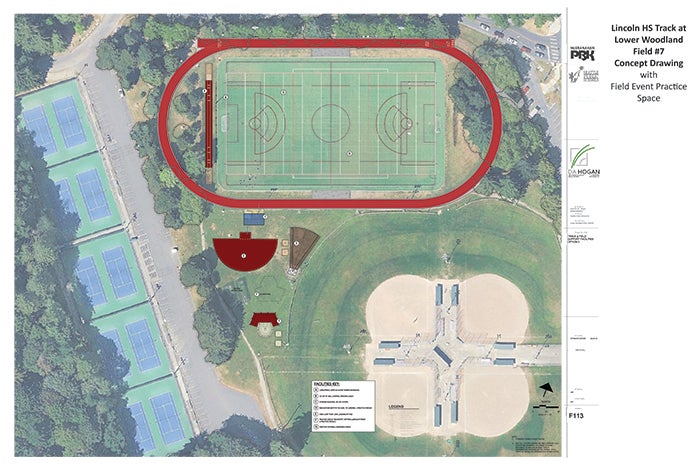
SPS and Seattle Parks & Recreation (SPR) have agreed to move forward with the track upgrades at Lower Woodland Field #7, which is owned by SPR. These improvements will support Lincoln’s robust track and field program. Our goal is to make the space functional for both track and cross country.

Concept Image

This image shows how the new track and related facilities could be located. It is not a final design.

Track concept image

Frequently Asked Questions About the Track

Lincoln High School is the only high school in the district without track (or an athletic field), which limits opportunities for Lincoln’s students. For many students, after-school sports such as track, soccer, and football are a big part of their high school experience. The lack of facilities requires Lincoln students to travel to distant fields, disproportionately affecting students without access to reliable transportation.

Lincoln athletes currently use track and field event facilities Ingraham High School, about five miles from Lincoln High School. Ingraham has priority in scheduling, so Lincoln practices are scheduled later in the day or early in the morning.

The Lower Woodland Field #7 track upgrades will provide a “home field” for Lincoln’s extensive track program. This will allow track practice to take place after school instead of needing to adjust schedules to fit in around use of another school’s use of their track facility. It also reduces the need to take buses to Ingraham for practice.

SPR is a close partner to SPS in identifying potential locations and logistics for building the track and the full-size athletic field. Collaboration will continue during design and construction.

Seattle Parks & Recreation will own any facilities built at Woodland Park. The track will be added to the interlocal agreement between SPS and Seattle Parks & Recreation. This agreement provides SPS students with athletic facilities and allows those facilities to be used by the larger community outside of set school use.

Yes. The upgraded track can provide space for both the school and for the broader community. Seattle Parks & Recreation (SPR) field inside the track will remain part of the SPR inventory of fields that is part of the interlocal agreement between SPS and SPR. The track will be added to the interlocal agreement.

SPS and Seattle Parks & Recreation (SPR) are aware of the long-standing use of Lower Woodland for Metro League Cross Country meets. While resurfacing the dirt track will improve conditions for track athletes and the public, care will be taken to ensure the XC course remains safe and accessible. Planners will consult with SPR representatives to ensure the track design avoids obstacles, such as curbs or fences that could interfere with XC.

Yes. The plan is to surface the track in a way that ensures smooth transitions for cross country runners. Feedback from coaches and the running community will shape the final design to minimize hazards and maintain access to the XC course. The goal is to make the space functional for both track and cross country.

Lower Woodland Field #7 already has lights and minimal bleachers. The lights will remain, and the bleachers will be replaced. The initial fit test designs include space for field event practice including shot put, long jump, discus, and other field events. A storage building will be added to store track and field events equipment.

Transparency is a cornerstone of this project. We will share information openly, hold public meetings and information sessions, and provide updates as plans evolve. Community feedback will be documented and used to guide decisions at every stage of the process.

The Lincoln High School Athletic Field and Track projects are two parts of a project approved as part of the 2022 Buildings, Technology, and Academics/Athletics V Capital Levy. Funding included in voter-approved capital levies must be used for the designated capital improvements to schools and school facilities. The funds cannot be used for operating costs.

Locating the track and athletic field at Woodland Park will keep both facilities within the same park but not adjacent.

While we are studying locations at Woodland Park to potentially site the athletic field, we do not anticipate that there will be space for both a track and field. We are planning upgrades to the track at Lower Woodland #7, but that field is not large enough to also include the new athletic field. In addition, upgrading the existing field would displace any athletic activities that currently take place on the field.