Seattle Public Schools

High School, Postsecondary, and Career Planning

High School and Beyond Plan

Preparing Students for College and Career

The High School and Beyond Plan (HSBP) is a Washington State graduation requirement.  As an important step in transitioning to life after high school, the HSBP helps students focus on setting goals, as well as preparation and readiness for future work, career and/or college.  

Starting in middle school, students work with their families and school staff to develop their HSBP.  Students continue to revise their plan each year through middle school and high school as their interests and/or goals change.  

SPS transition to SchooLinks, a new HSBP platform 

Beginning in September 2026, our district will transition from Naviance to SchooLinks, the state-selected HSBP platform for Washington schools. This shift ensures alignment with state requirements while providing improved tools for students to explore their interests, plan for life after high school, and track progress toward their goals. SchooLinks also expands access for families, creating new opportunities to engage in their student’s planning process. More information, including access details and training resources, will be shared ahead of the launch. 

Frequently Asked Questions

What is the High School and Beyond Plan (HSBP)

The High School and Beyond Plan (HSBP) is a state graduation requirement designed to help students explore careers or college pathways starting in 6th grade in Seattle Public Schools. It centers on students reflecting on three guiding questions: Who am I?, What can I Become? and How do I Become That? Throughout the year, students update their HSBP goals to reflect their changing interests and goals, connecting what they learn and the skills they develop to future career pathways.

Why is Seattle Public Schools using the tool SchooLinks to help students complete their High School & Beyond Plan?

With the passage of Senate Bill (SB) 5243 in 2023, OSPI began moving to transition all public schools serving students in grades 7-12 to one statewide platform for HSBP. In May 2024, SchooLinks was introduced as the new statewide platform for Washington State.

On this page, you’ll find a short video explaining the “why” behind this exciting transition, along with key information about student pathways, the implementation timeline, and training and support for educators, families, and school staff. 

Prior to the passage of (SB) 5243, districts varied in what tools they used for HSBP, meaning not all students had access to the same resources. Switching to the universal platform from SchooLinks ensures every student in Washington will have equal access to high-quality career and college readiness tools.  

How does SchooLinks help students develop their postsecondary plans?

llows students to adapt and customize their pathway that feels like the best match for them. Examples of these pathways include: 

  • 2-year college: associate degrees and workforce credentials
  • 4-year college: bachelor’s degree programs and further university preparation
  • Apprenticeship programs: hands-on training in skilled trades and technical careers
  • Direct workforce entry: immediate employment opportunities, and career training
  • Military service: armed forces career preparation

SchooLinks gives students an easy-to-use space to explore careers, plan for career and college pathways, and map out steps toward their goals. Through the platform, students can:

  • Discover career pathways that match their interests and strengths
  • Explore career and college opportunities
  • Track their goals and progress from 7th through 12th grade
  • Choose school courses to build on skills needed for their career(s)of interest

With SchooLinks, every student has access to the same high-quality tools to plan a future that fits them.

How does having SchooLinks serve as the one High School & Beyond Plan platform help students and families?

Using one statewide online HSBP platform gives students and families across Washington access to helpful services, including:

  • Assistance for students and families to better understand and navigate the college application, financial aid, and scholarship processes. 
  • Ensuring access to the universal online HSBP platform for another year empowers students and families across Washington to access beneficial services the platform provides, including but not limited to: 
  • Ability for parents, guardians, and families to learn about how their students’ interests and skills connect to potential career and college opportunities as a means of helping them make informed course decisions and stay engaged in school; 
  • Capability for a student’s HSBP to move more seamlessly from district to district, which is especially important for highly mobile populations; 
  • Opportunities for students and families to directly connect with school counselors and educators; 
  • Capability for students and families to access the platform in more than 100 languages; 
  • Options to explore trade, apprenticeship, and military career opportunities; 
  • Ability for students to connect with local employers, internships, job shadowing offerings, and career-connected opportunities based on their career interests; 
  • Access to essential career and college preparation events, such as career, college, and financial aid fairs; and 

What are the required elements of the High School and Beyond Plan?

The requirements of the High School and Beyond Plan are described in RCW 28A.230.212 and in WAC 180-51-220. Decisions about whether a student has met the requirements for the High School and Beyond Plan are made locally per RCW 28A.230.212. The HSBP helps to bridge the other two components of the Washington diploma: it helps to guide selection of the individual student’s courses and graduation pathway option, based on the career and education goals identified in the individual student’s plan.

  • Identification of career goals aided by a skills and interest assessment.
  • Identification of educational goals.
  • A four-year plan for courses taken in high school that satisfies state and local graduation requirements and aligns with students’ secondary and postsecondary goals that may include education, training, and careers.
  • Options for satisfying state and local graduation requirements, taking into account academic acceleration (RCW 28A.320.195), dual credit courses, Career and Technical Education programs, and graduation pathway options.
  • Resume or activity log, that includes the student’s education, work experience, community service, including how districts recognize community service (RCW 28A.320.193)
  • Evidence that the student has received information on federal and state financial aid programs that help pay for postsecondary programs, including evidence that the student has received the following information:
    • Documentation necessary for completing financial aid applications, information provided on the Washington Student Achievement Council (WSAC) website about the FAFSA (Free Application for Federal Student Aid) and WASFA (Washington Application for State Financial Aid)
    • Application timeliness and submission deadlines, and the importance of submitting applications early
    • Information specific to students: 1.) who have been in foster care, 2.) who are, or are at risk of, being homeless, or 3.) whose family member or guardians will be required to provide financial and tax information necessary to complete application
    • Opportunities to participate in sessions that assist students and, when necessary, their family members or guardians, in filling out financial aid applications.
    • Information on the College Bound Scholarship application and eligibility

What are schools and districts required to do to support the High School & Beyond Planning process?

Districts and schools must create processes for High School and Beyond Planning that support the following:

Middle School

Inform 7th and 8th grade students of the college bound scholarship program established in chapter 28B.118 RCW.

  • By seventh grade, each student must be administered a career interest and skills inventory that will help inform the student’s eighth grade course taking and initial identification of their education and career goals.
  • By eighth grade, each student must have begun development of a high school and beyond plan that includes a proposed plan for first-year high school courses aligned with graduation requirements and secondary and postsecondary goals.
  • Involve parents and guardians in the process of developing and updating the high school and beyond plan. The plan must be provided to the student’s parents or guardians in their native language if that language is one of the two most frequently spoken non-English languages of students in the district. Districts are also encouraged to provide plans to parents and guardians in additional languages as needed, to the extent feasible.

High School

  • Update the plan annually, at minimum to address:
    • High school assessment results informing course-taking in junior and senior year
    • A student’s changing interests, goals, and needs, including identifying the graduation pathway option or options the student will pursue.
    • Interventions, academic supports, and courses that will enable the student to graduate high school.
  • Students in foster care, students who are dependents of the state and ninth grade students who may be eligible must also be provided with information on the program. Students in the college bound scholarship program should be reminded about program requirements to remain eligible and provided with information about filling out a financial aid application in their senior year.
  • The student’s High School and Beyond Plan should be used to guide the choice of a third credit of both math and science, based on the student’s individual goals.
  • For students who have not earned a score of level 3 or level 4 on the middle school math state assessment, the plan must include taking math courses in ninth and tenth grade. The math courses may include career and technical education equivalencies in math, established in RCW 28A.230.097. For students who have not earned a level 3 or level 4 on their middle school English language arts exam or their middle school science exam, districts are encouraged to inform students of supports and courses that will address the students’ learning needs and be considered in the students’ course-taking plans.
  • For a student with an individualized education program (IEP), the student’s IEP and high school and beyond plans must align. Students with an IEP transition plan, which begins during the school year in which they turn sixteen, may use their transition plan in support of, but not as a replacement for, their high school and beyond plan. The process for developing and updating the student’s HSBP must be similar to and conducted with similar school personnel as for all other students. The student’s HSBP must be updated in alignment with the student’s school to postschool transition plan.

What does state law say about both what must be included in the plan and how it should be supported across districts?

RCW 28A.230.212 establishes the core requirements for every student’s HSBP. Plans must include career and college goals, a personalized four-year course plan, activities that support exploration and planning, and, when applicable, alignment with a student’s IEP transition plan.

RCW 28A.230.215 requires OSPI to provide one online platform that supports the development and management of HSBPs. The platform ensures equitable access, consistency across districts, and portability of plans as students move. OSPI has selected SchooLinks as the statewide platform, with phased implementation beginning in 2025.

What steps are taken to ensure student data shared in SchooLinks is protected?

Seattle Public Schools requires SchooLinks to follow strict student data privacy and security rules.

Student data remains owned and controlled by the district, is used only for educational purposes, and cannot be sold or used for advertising.

SchooLinks must limit access to authorized users, maintain strong security safeguards, promptly report any data breach, and securely delete or return data when it is no longer needed.

Parent and student rights under privacy laws are fully protected.

When will this change take place?

Naviance will continue to be used through the 2025–26 school year

SchooLinks will officially launch for students and families in September 2026

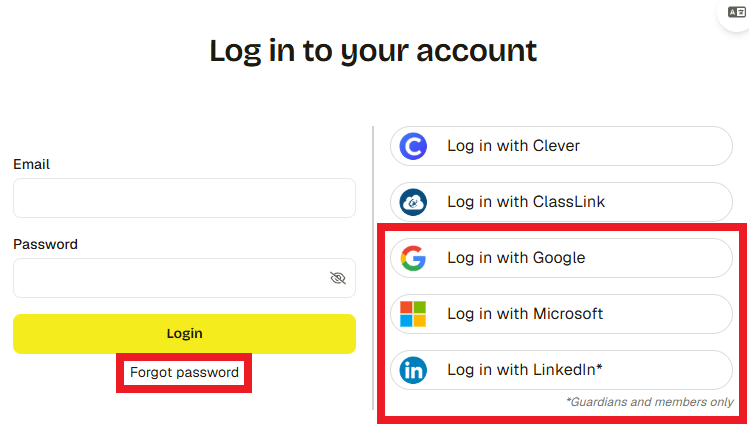
How can my student access SchooLinks?

  • Accounts are automatically created by Seattle Public Schools
  • Students log in using their SPS username and password (through Clever or a school-provided link)

For student directions on how to login, visit Clever Student Portal.

Will families have access to SchooLinks?

Yes. SchooLinks includes family access, allowing you to:

  • View your student’s High School and Beyond Plan and progress
  • Explore college and career options together
  • Stay informed about important milestones and next steps

More information about how to create and access family accounts will be shared before the launch.

Can a student opt out of using SchooLinks specifically?

No, there is not a specific opt out process for SchooLinks. SPS does have a process to opt out of general internet access.

The SPS Network Use Agreement outlines the standards for appropriate use of SPS computers and internet network. All students with individual network accounts are required to accept the SPS Network Use Agreement when they first log on to the district network and when there are changes to the agreement. Read more about the SPS Network Use Agreement.

Specifically, for parents that wish to opt “out” of general internet access by enrolling their child into a restricted-internet configuration, please email cybersecurity@seattleschools.org.

Will students receive training on how to use SchooLinks?

Yes. Students will receive support through:

  • Classroom lessons connected to their High School and Beyond Plan
  • Guidance from school counselors and staff
  • Step-by-step tutorials and resources

Families will also receive information to help support students at home.

How can I learn more about SchooLinks?

Check out a SchooLinks for Guardians slideshow presentation to learn how students use SchooLinks for goal-setting and post-graduation planning, what you can see as Parent/Guardians, and resources for support from SchooLinks.

Who can I contact if I have questions?

If you have questions about the transition, please Contact School Counseling Team.


Data Security and Privacy

Seattle Public Schools takes student data privacy seriously. When student information is shared with SchooLinks, strict safeguards are in place to protect it at every step.

All student information shared with SchooLinks remains the property of Seattle Public Schools. SchooLinks may only use student data to provide services approved by the district and must follow district direction at all times.

Only authorized individuals who need student data to support educational services are allowed access. SchooLinks is required to limit access, monitor for unauthorized use, and immediately notify the district if suspicious activity is detected.

SchooLinks must follow industry‑recognized cybersecurity standards and maintain administrative, technical, and physical safeguards to protect student data from unauthorized access, misuse, or disclosure.

Student data may never be sold or used for targeted advertising. Information shared with SchooLinks cannot be used to market products or services to students.

If there were ever a data breach, SchooLinks is required to notify Seattle Public Schools within 72 hours of confirming the incident and to cooperate fully with investigation and response efforts. The district would then notify affected families as required by law.

When the district’s agreement with SchooLinks ends or if the district requests it, student data must be securely deleted or returned according to agreed‑upon timelines and procedures.

Families continue to have rights under state and federal privacy laws. Requests to review or correct student records are handled through Seattle Public Schools using established procedures.

In short

Seattle Public Schools requires SchooLinks to:

  • Use student data only for educational purposes
  • Follow strict security and privacy standards
  • Prevent unauthorized access or misuse
  • Never sell or advertise using student data
  • Respond quickly and transparently to any security incident

These requirements are legally binding and designed to keep student information safe while supporting college and career planning.